
Pentax K-70 Review

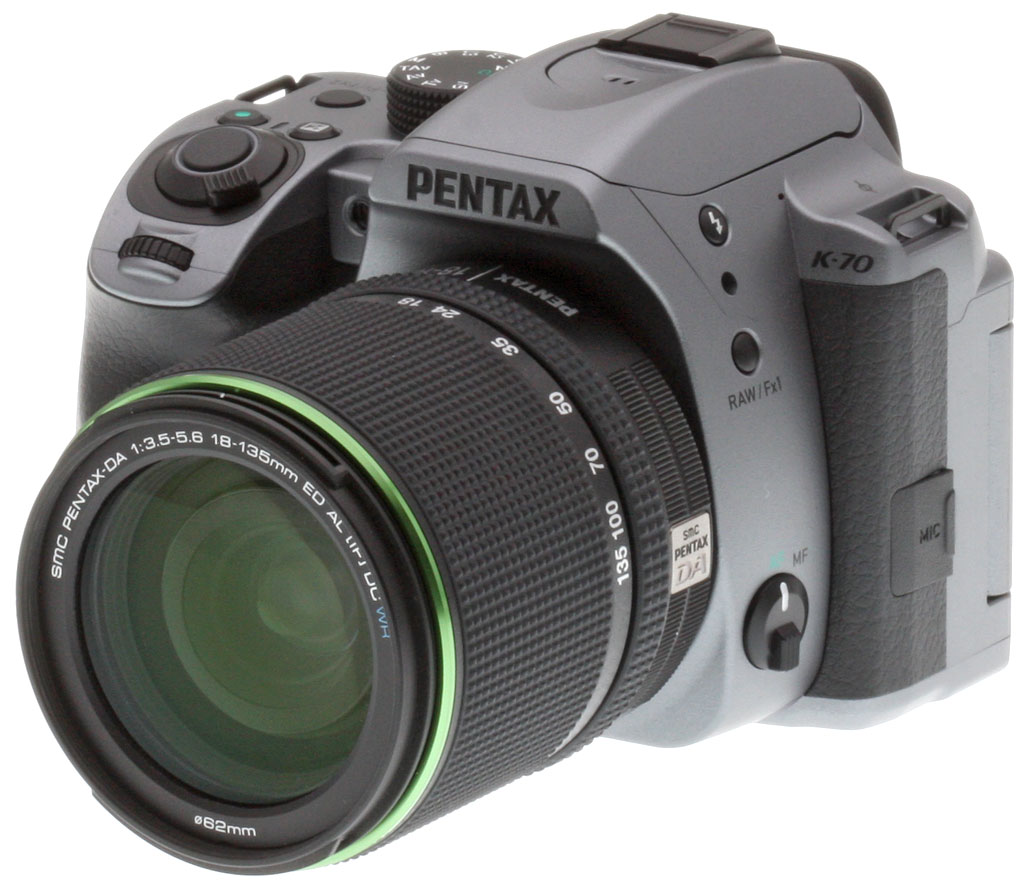
Updates:
06/09/16: Technical Info added
10/15/16: Field Test added
10/31/16: Performance test results added
11/01/16: Image Quality Comparison and Print Quality Analysis added
11/02/16: Conclusion added
For the last couple of years, the entry-level point in Ricoh’s DSLR lineup has been occupied by the company’s K-S series, first with 2014’s K-S1, and later with 2015’s followup K-S2. Both cameras featured controversial love-it-or-hate-it styling, but beneath their rather divisive skins you could expect to find unusually comprehensive feature sets. And both also debuted brand-new features for the company’s cameras.
That, as we found out in an interview early in 2015, was no mere coincidence. Within Ricoh, the K-S series was seen as a proving ground for new innovations. And these weren’t cameras aimed at existing Pentaxians, but rather were designed to bring in users from other brands — or perhaps those considering stepping up to an interchangeable-lens camera for the first time.
K-S series innovations paired with more grown-up K-series styling
Now, the brand-new Pentax K-70 arrives to take those features into a more mainstream camera, as hinted at by a return to the company’s long-running K-* branding. Thanks to more conventional styling and some very worthwhile upgrades, the K-70 appeals not just to the younger crowd who’ve yet to purchase their first Pentax camera, but also to Pentaxians looking to upgrade from an earlier model.
Gone are the flashing lights of the K-S1, as well as the two-tone body and unusual top-deck materials and textures of the K-S2. In their place, the brand-new body of the Pentax K-70 sports a more mature aesthetic in one of two traditional body colors — either black or silver. Both variants are wrapped in black leatherette trim, giving the K-70 an altogether more serious look.
A familiar control layout and comprehensive weather-sealing
Although the Pentax K-70 forgoes the more eyecatching aesthetic of the K-S2, the basic control layout is very similar to that camera. The K-70’s body is weather-sealed for resistance to rain, snow and dust, just like that of the K-S2 before it, and it’s also freezeproof to 14°F (-10°C).
The main controls — particularly the Mode dial — have been tweaked for better handling when wearing gloves. (The new Mode dial is both taller, and returns to a diamond-knurled finish that makes for an easier grip when turning the dial.)
The Pentax K-70’s new imaging pipeline boasts higher resolution and sensitivity
With the K-70, Ricoh brings its entry-level APS-C cameras right up to date thanks to an overhauled imaging pipeline. Gone is the 20-megapixel sensor of the K-S series cameras, replaced by a 24.24-megapixel sensor that puts the K-70 in the same league as the flagship K-3 and K-3 II siblings, resolution-wise.
As in both the K-3 and K-3 II, the Pentax K-70 also opts for 14-bit readout, instead of the 12-bit readout of its predecessors. And as is par for the course these days, there’s no anti-aliasing filter, with Pentax’s clever on-demand AA Filter Simulation function instead provided to help combat moiré when needed.
Performance, too, has been improved since the K-S2
Unlike the flagship models, though, the K-70 retains the same PRIME MII image processor which was used in the earlier K-S1 and K-S2. Burst performance was measured in our lab at just a hair over six frames per second, more akin to the 5.4-5.5 fps of the K-S1 and K-S2 than the 8.3 fps of the K-3 and K-3 II.
In one respect, though, the Pentax K-70 bests not only the K-S1 and K-S2, but also both of its flagship APS-C siblings. Where those cameras all topped out at ISO 51,200-equivalent, the K-70 has a maximum sensitivity of ISO 102,400-equivalent.
Finally, on-chip phase-detect and full-time movie AF come to Pentax!
It might not be part of the innovation-oriented K-S series, but as the spiritual successor of the K-S1 and K-S2, the Pentax K-70 boasts other firsts for a Pentax DSLR, too. Perhaps the most exciting of these is a new hybrid autofocus system that, for the first time in a Pentax camera, couples contrast-detection autofocus with on-sensor phase detection pixels.
Although it can be a bit prone to hunting, this change still makes for better and faster autofocus in live view. It also means that for the first time in a Pentax DSLR, the K-70 will offer full-time continuous autofocus during movie capture — and that’s potentially a big deal in a camera aimed at consumer use. (However, it’s not as big a deal as it could have been, as we found the K-70’s movie AF, too, was too-easily confused and rather prone to hunting.)
Refined aperture-control for movies, too, but no true 4K capture yet
Speaking of movies, there’s another intriguing note in the launch of the Pentax K-70: Ricoh tells us that there’s a new aperture-control function which, it says, will “automatically assure a proper exposure level even in fluctuating lighting conditions during movie recording”. This function only works with one lens at launch — the simultaneously-announced HD PENTAX-DA 55-300mm F4.5-6.3ED PLM WR RE zoom lens — but we’d expect to see further Pentax lenses gaining this capability in the future. Sadly, this lens was not available to us during our review of the K-70, and so we’ve been unable to test it.
As for what the aperture-control function is doing, we’re guessing that it allows for automatic aperture changes during video capture as dictated by changes in scene brightness, perhaps if the shutter speed and/or sensitivity stray beyond certain limits. Press materials for the lens itself suggest that aperture control noise is minimal and shouldn’t be picked up too much by the K-70’s onboard stereo microphone. Hopefully the updated mechanism also allows for more gradual aperture changes to reduce the impact on the recorded video.
Sadly — but not surprisingly — there’s no native 4K video capture in the Pentax K-70, though. Instead, regular video tops out at 1080p30 or 1080i60 max. (1,920 x 1,080 pixels; 30 frames per second progressive-scan or 60 interleaved fields per second.) Your only option for native 4K video with the K-70 is to shoot a time-lapse video, something Pentax DSLRs have offered for a few years now.
The Pentax K-70 also sports all the sensor-shift goodness we’ve come to expect
Ricoh has not surprisingly retained its in-body Shake Reduction system for the Pentax K-70, and along with it the raft of clever alternate uses for the system that we’ve seen in past models. The system is said to have a 4.5-stop corrective strength, which puts it in the same class as the flagship APS-C model, the K-3 II, a fair bit better than the three-stop correction of the K-S2, but not quite as good as the five-stop correction provided in the full-frame Pentax K-1.
As well as helping to fight blur from camera shake, the system is also used to provide for the aforementioned AA Filter Simulation function, and to correct for tilted horizons automatically. It’s also used for the detail-boosting, multi-shot Pixel Shift Resolution function which debuted in the Pentax K-3 II, but with the inclusion of the motion correction function which was added in the K-1. This won’t allow handheld shots, but should be able to account for moving subjects within the scene. (These won’t gain the benefit of added sharpness, but the rest of the frame will.)
And if you own the company’s optional O-GPS1 accessory, the Pentax K-70 will also be able to freeze star trails, too.
The K-70 uses a brand-new cable-switch for remote shutter release
Speaking of optional accessories, there’s a brand-new one being offered alongside the Pentax K-70. The CS-310 Cable Switch is the only wired cable release compatible with this camera, and it connects using the built-in microphone jack on the left side of the camera body. It has a one meter-long cable, and offers an alternative to using an infrared remote control or capturing via Wi-Fi from your smartphone. This, again, was not available to test during our review of the camera, unfortunately.
Many other Pentax K-70 features carry over from the K-S2
There are certainly plenty of new or updated features in the Pentax K-70, but a fair few also carry through unchanged from the preceding K-S2 model. These include the near-100% glass pentaprism viewfinder with 0.95x magnification, a side-mounted tilt/swivel LCD monitor, and a SAFOX X phase-detect autofocus system with 11 points, of which nine are cross-types. Also retained are the 77-segment metering system, top shutter speed of 1/6,000-second, and built-in Wi-Fi wireless networking to put images on your phone as quickly as possible.