
Fujifilm GFX100RF Puts 102 Megapixel Medium Format Sensor Into Compact, Vintage Body

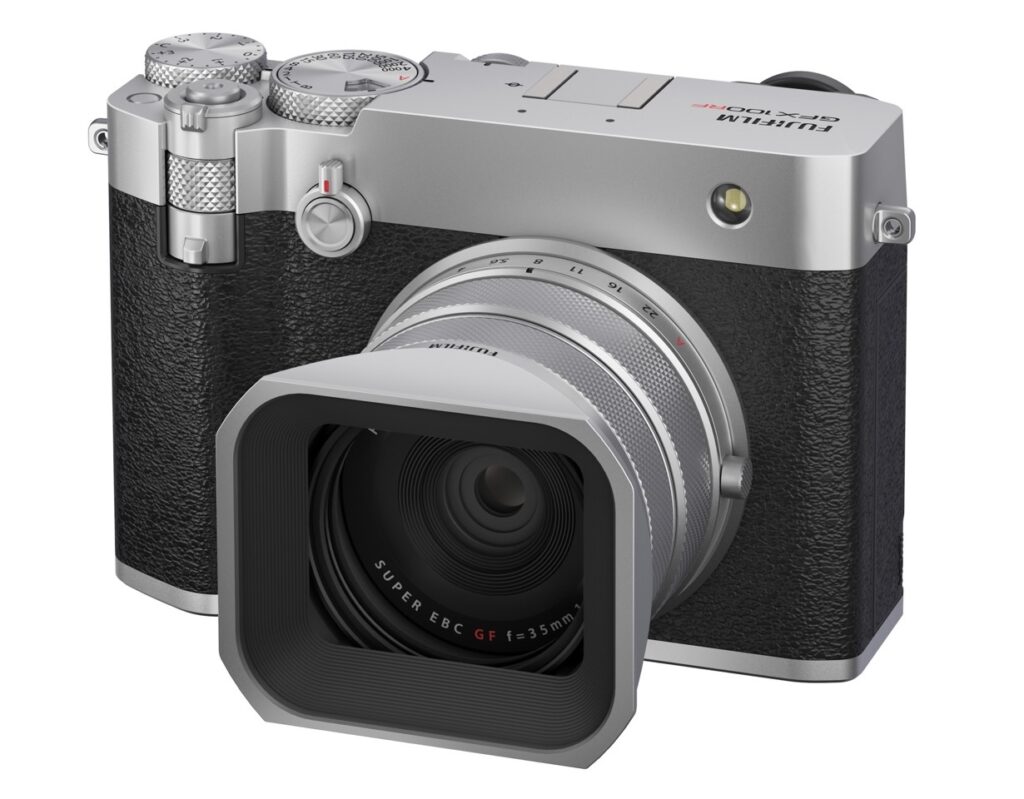
Table of Contents
-
 Watch Our Review of the Fujifilm GFX100RF
 -
What Was Special About the Fujifilm X100
-
Pixel Size, Not Pixel Resolution, Determines Light Gathering Capabilities
-
Image Stabilization? There is None
-
Image Quality is Superb, Mostly
-
Body, Lens, and Styling of the GFX100RF
-
GFX100RF Autofocus
-
Digital Teleconverter and Other Curiosities
-
Viewfinder and LCD Screen on the GFX100RF
-
GFX100RF Video Capabilities
-
Direct-To-Cloud Transfer with Frame.io
-
Pricing and Availability of the Fujifilm GFX100RF
 Watch Our Review of the Fujifilm GFX100RF
The Fujifilm X100 series has a cult following thanks to the camera’s compact form factor, “vintage” design aesthetic, and excellent lens image quality. Fujifilm’s APS-C sensors power the X100 series, and today, Fujifilm gives the X100 a medium-format-sensor sibling with the GFX100RF.
The GFX100RF is what happens when the size of Fujifilm X100 and the sensor size of Fujifilm’s GFX medium-format cameras are combined into one impressive unit. It’s both massive and small. The sensor is huge, and the body is compact. In many ways, this is the best of all worlds.
Watch Our Review of the Fujifilm GFX100RF
What Was Special About the Fujifilm X100
I purchased my first X100 camera when it launched in 2011, and it quickly became my favorite travel camera. Despite the fixed lens, the X100 was small enough to look inconspicuous when traveling and produced amazing results.
At the time, the iPhone 4S was Apple’s most powerful smartphone, but it couldn’t touch the X100. While I owned a Canon EOS 1Dx, I only took it on trips where I was shooting for work because of its weight and value.
The original X100 came out years before the full-frame Sony a7 (Alpha 7), and until that came to market, the X100 was my go-to travel body. APS-C has definite advantages for body size and performance, but many photographers prefer full-frame thanks to the low-light performance of those sensors.
Pixel Size, Not Pixel Resolution, Determines Light Gathering Capabilities
The GFX100RF uses a sensor that’s around 1.7 times larger than a full-frame sensor and nearly a four times greater area than APS-C. That’s a staggering amount of light.
All things being equal, the bigger the sensor, the more light-gathering ability and often the more dynamic range. That’s because the size of the pixel “wells,” the individual light-sensing pixels, determines low-light performance. The size of these wells is called the pixel “pitch,” and the higher the value, the bigger the pixels.
To explain this with an analogy, imagine you have a cup and a bucket. If you put both outside when it’s raining, they’ll have the same water height when the storm passes. If you have one inch of rain, both the cup and bucket will have the same water height.
While they have the same “resolution” in this example, the bucket gathers much more water by volume. In this analogy, the bucket’s “sensitivity” is greater, as it gathers muchmore water simultaneously.
Image Stabilization? There is None
The most disappointing thing about the GFX100RF is the lack of In-Body Image Stabilization (IBIS). Let me tackle this before I touch on the other positive aspects of the camera, as it’s the subject that reviewers like myself have hit on the most.
There is no IBIS in the GFX100RF. There is no optical image stabilization (OIS) in the lens either.
That might not seem surprising, since it’s a compact medium format camera, but unlike an interchange lens camera, there’s no way to add a lens with OSS tro make up for the lack of internal stabilizaiton.
It’s a fair point to say that one wouldn’t expect IBIS nor OIS in a camera this size, but it would not be impossible to do so. The Leica Q3 has optical stabilization on the lens, and Fujifilm’s interchangeable-lens GFX camera does as well, and it’s very capable.
The lack of IBIS is something we also pointed out in our review of the Sony RX1R III. At this price point IBIS would be incredibly useful. Especially for street photographers, having a stabilized body would elevate this to a much higher level, and would make it one of the best fixed-lens cameras.
So I don’t belabor the point, let me say it was one of the few disappointments with the camera. When photographing at a parade, where I had to pan quickly to keep up with moving subjects, there was a lot of motion blur, something even a smartphone doesn’t suffer from.
With that out of the way, let’s talk about the more positive aspects of the camera.
Image Quality is Superb, Mostly
Even more than image stabilization and autofocus (see below for more on that), a camera is judged by its image quality, and unsurprisingly, the image quality on the GFX100RF is superb. It has a look that’s unmistakably Fujifilm, with good saturation, great dynamic range, and nice background defocus.
In bright sunlight, the images are slightly washed out, though that’s easy to fix in post, and not uncommon in camera bodies. I think the metering on the GFX100RF tends to overexpose if not set manually, and shooting in manual mode mostly fixes the contrast and saturation drop in super-bright situations.
This image was taken around noon, with a very bright sun. The details in the foreground and background shadows disappears.
A flat, washed-out image is typical in conditions like this, and straight out of the camera, this image feels unusable. Thanks to the dynamic range of the sensor though, there’s plenty of detail in the highligths and shadows to pull good images out of bad lighting conditions.
In more reasonable conditions, the images are just superb. If you’re going to buy this camera for any one reason, this is the reason. You’re getting fantastic resolution and fantastic colors, gerneally righ out of the box. Images that seem unusable are often fixable in post with less work than a 35mm would need, and there is much more latitude than I’ve seen on Fujifilm’s compact APS-C X100 lineup.
Body, Lens, and Styling of the GFX100RF
The GFX100RF has a machined aluminum enclosure that looks like the X100VI was stretched slightly in height and depth. The black body features a textured surface, making the camera easier to hold and use than the traditional GFX body.
To fit the sensor into a body this small, Fujifilm used a focal plane shutter instead of a leaf shutter. There are no practical limitations to the photographer due to this choice.
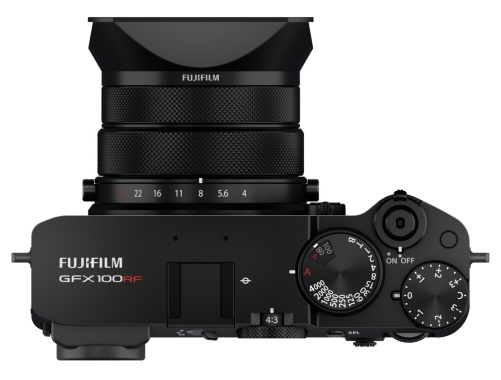
Like the X100VI, the GFX100RF has a fixed lens. In this case, it’s a Fujinon 35mm f/4 lens, a 28mm f/3.5 equivalent in full frame. Fujifilm lauds the lens’s optical design due to the collection of 10 elements in eight groups, including two aspherical lenses, to reduce chromatic aberration and ghosting.
The company’s Nano-GI coating reduces internal reflections, and the minimum focus distance is 7.9 inches (20cm).
There is also a built-in neutral density filter built in, something I wish all cameras had.
The only curious aspect of this camera’s design is its lens choice. It has amazing resolution, but the 28mm lens makes it unsuitable for portraits or other close-subject work. This focal length is more appropriate for landscapes and street photography, limiting the camera’s use for many.
GFX100RF Autofocus
The camera uses what Fujifilm calls an “AF prediction function,” which I think just means it has autofocus. (AF, after all, is just predicting where a subject will be to keep in focus.) The company says the GFX100RF can detect human faces and eyes, animals, vehicles, birds, and airplanes.
In my tests, I found the GFX100RF has decent autofocus, though not on par with similarly priced mirrorless cameras. That’s to be expected in a camera with such a large sensor, though the GFX 100 II has autofocus that felt faster than this camera did.
Few people would use a camera like this for sports or other fast-moving subjects, so the AF speed is on point for the type of photographyt his camera is designed for.
When looking at portraits and street photography the AF is spot on, and the images are tack sharp.
Digital Teleconverter and Other Curiosities
Fujifilm showed off the “digital teleconverter” dial, which lives in front of the camera. The PR team and the press materials discuss the ability to change the focal length (angle of view) with this dial as if this were not just an in-camera crop of the sensor area.
This dial is unnecessary for RAW shooters, as the full sensor area is always maintained in RAW images. Cropping in an image editor is a better solution, as it allows for custom crop placement. The rear of the body has an aspect ratio dial that “crops” to 3:4 or 17:6, but this has no effect when shooting RAW.
When shooting in JPEG, the digital crop and aspect ratio crops are maintained, so these are handy for quick JPEG use, but many will find these dials unnecessary.
Fujifilm took a play from the smartphone handbook with a “Surround View” mode that shows the whole sensor capture area with a crop line superimposed for these in-body digital tele and aspect ratio tools.
This on-screen display is why the letters “RF” are in the name-rangefinder cameras use crop boxes to show the photographer what the final image area will look like
Viewfinder and LCD Screen on the GFX100RF
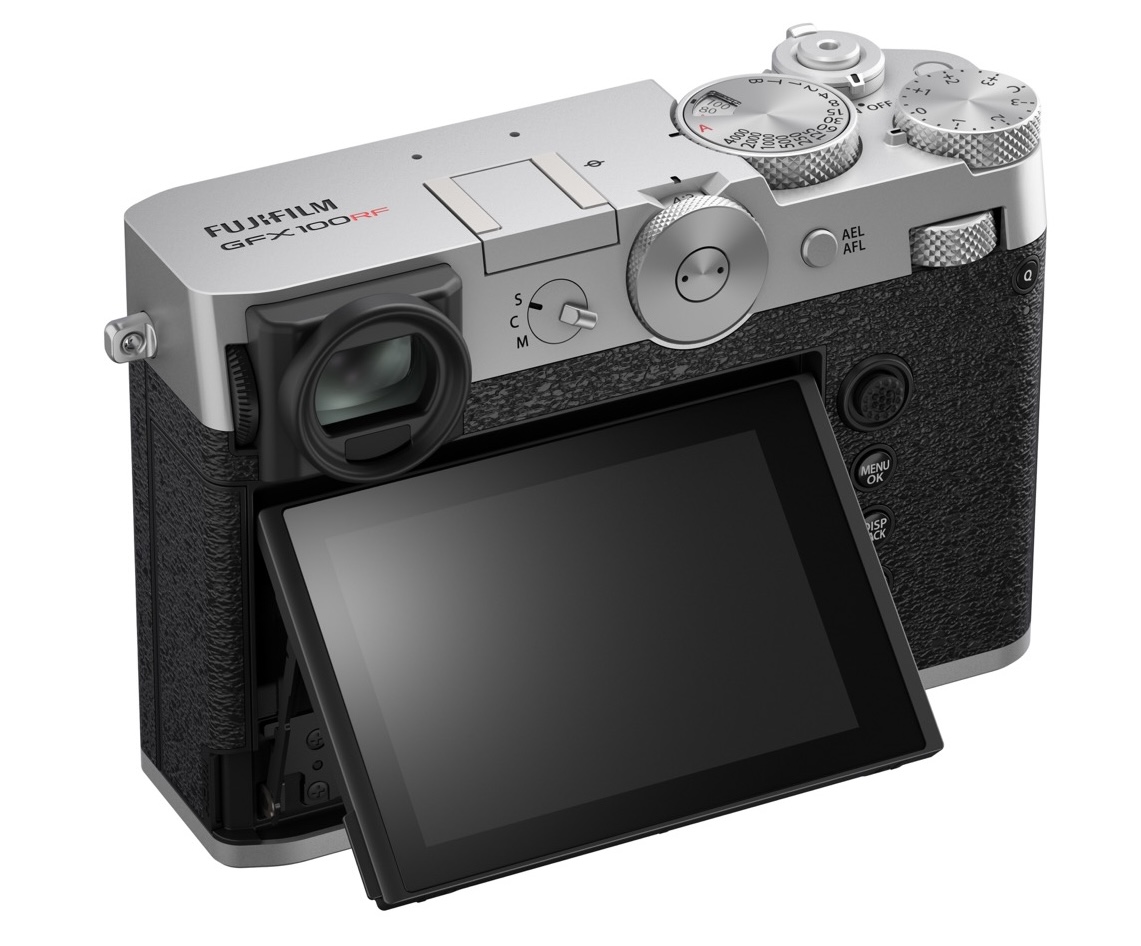
The only place Fujifilm has compromised is in the resolution of the EVF and LCD screen. The EVF has a 5.76 million dot resolution, which is not bad per se but is below what I would expect for a camera of this design. It’s well above the resolution of the Nikon Z9, but around four million dots less than the Sony Alpha 1 II and the Canon R1. The rear LCD screen has just over two million dots, lower than many full-frame cameras.
GFX100RF Video Capabilities
Video will probably not be at the top of users’ minds for the GFX100RF, but it is surprisingly capable, nonetheless. The camera can capture 4K/30p in 4:2:2 10-bit, with a claimed 13 stops of dynamic range when shooting F-Log2.
The GFX100RF has headphones in and out jacks and a mini-HDMI port to accommodate video use.
Direct-To-Cloud Transfer with Frame.io
The GFX100RF lets you send photos and videos directly to Adobe’s Frame.io service. I’ve used Frame. Io-capable cameras and the workflow is excellent. Files from the camera arrive for post-processing without waiting for images to be downloaded to a computer.
Most companies use their own cloud storage service, but Frame.io is more robust and integrated with Adobe’s offerings.
Pricing and Availability of the Fujifilm GFX100RF
The Fujifilm GFX100RF is now on sale from major online retailers.