
Olympus 50-200mm f/2.8-3.5 Zuiko Digital Review

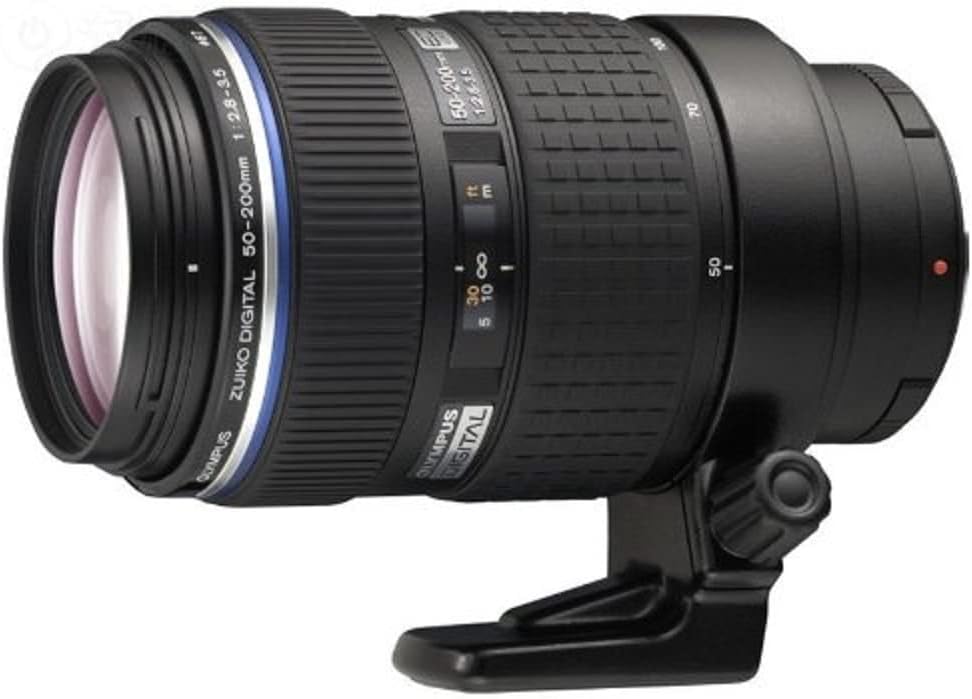
Table of Contents
 Features & Performance
The Olympus 50-200mm Æ’/2.8-3.5 Zuiko digital lens forms part of Olympus’ High Grade’ lineup of lenses, developed for the top-level brightness, close-up shooting capabilit,y and sharpness. The lens is built with ”Dust and splash-proof construction” which allows the lens to be used even in harsh conditions. Available for around $900.
Since Olympus digital SLR cameras employ the four-thirds imaging sensor, any lens attached to the body will have an effective focal length (in 35mm terms) of double the listed length. Thus, for this particular lens, it will exhibit an effective focal length of 100-400mm. The lens takes 67mm filters, and comes with several accessories: a bowl-style lens hood, a lens carrying case, and a lens-collar tripod mount.
This lens isn’t a ”constant” lens, in that as you increase the focal length, the maximum aperture size decreases. The following table reflects the change as you zoom:
| Focal length | 50mm | 92mm | 117mm | 137mm | 147mm | 158mm | 182mm | 200mm |
| Max. aperture | Æ’/2.8 | Æ’/2.9 | Æ’/3.0 | Æ’/3.1 | Æ’/3.2 | Æ’/3.3 | Æ’/3.4 | Æ’/3.5 |
These figures just correspond to the focal lengths marked on the lens; in actual usage, the widest aperture adjusts quite precisely in conjunction with the focal length setting. As you zoom in and out at the widest aperture, you can see the aperture changing in one-tenth increments.
Sharpness improves at Æ’/4, and the uneven sharpness seen above 100mm settles down. Below that, sharpness registers at 1 unit, which is about as sharp as we can measure. Optimal across-the-frame sharpness is obtained at Æ’/4, 70mm. Diffraction limiting starts to set in at Æ’/16, but even here you’re not exceeding 2 units on the blur scale. Even at its worst, Æ’/22 at 200mm, you’re at 3 units on the scale. Superior results.
(From Olympus lens literature) A high-performance digital specific telephoto zoom lens that’s one of the lightest and most compact in its class. This Zuiko Digital Lens includes 3 ED glass lens elements to correct chromatic aberrations and features a maximum aperture of f/2.8-3.5. Like all Zuiko Digital Lenses, the barrel and all connections are designed using all-metal components and rubber seals make it highly resistant to dust and moisture. The 50-200mm zoom comes with a lens case, lens hood, removable tripod adaptor front and rear lens caps.
Features & Performance
Chromatic Aberration
Resistance to chromatic aberration seems to be tuned to the wider-angle focal length settings for this lens, the worst registering at 3/100% of frame height when set to 70mm or below – these are results you would see only when looking at the individual pixels of an image, and even then, only in the corners. Above 70mm, the story changes a bit, and some CA shows up in the corners of the image (registers pretty consistently from 70-200mm at 6/100% of frame height, but these are still very small numbers).
Shading (”Vignetting”)
The 50-200mm has excellent performance with regard to vignetting. The only case where you see any shading of signficance is wide open at around 150mm, where there is almost a half-stop of light fall-off in the corners. The lab results also show a half-stop loss at 200mm, Æ’/22, but I couldn’t recreate it in practical testing.
Distortion
There are some points of distortion for this lens, but nothing so severe that it would even warrant correction in post-processing: in a nutshell, there is some barrel distortion evident below 70mm, and some pincushion above 70mm. Its worst point seems to be about 0.3% pincushion distortion when set to around 150mm. As if to confirm that this lens has been optimized for use at 70mm, this is the point where barrel and pincushion distortion meet, and there is 0% distortion according to our test chart.
Autofocus Operation
The 50-200mm autofocuses quickly, but not as quietly as we would have liked. It’s not a subtle noise, but it’s a small price to pay for excellent autofocusing performance. Point-to-point focusing is very quick and the noise is not so obvious in these cases; it’s only when the lens racks through the entire focus range that the serious motor noise comes into play.
Macro
The focus range scale on the lens shows a closest-focus distance of 1.2 meters (3.9 feet), and our results bear this out. Maximum image magnification is listed at 0.42x (in 35mm film terms), and the 50-200mm can be fitted with the Olympus EX-25 extension tube, increasing its magnification to 0.49x (35mm terms). This isn’t a lens that would be typically used for macro work.
Build Quality and Handling
The 50-200mm is very solidly built. It still seems to be finished with a fair number of plastic parts, but at 1,070 grams (almost 38 ounces, or 2.3 pounds), there’s a lot of glass and metal under the shell. The lens mount is metal, compared to the plastic of less expensive Olympus glass. The fit and finish of this lens is superb; the zoom and focus dials rotate with a velvety smoothness, and the textures have excellent traction. Setting it apart from less expensive Olympus lenses is a distance scale.
Mounted on the E-510, the camera balance is very top-heavy; this is not a lens intended for one-handed use. With two hands, it balances very nicely; however, you’re better off turning the tripod mount to the right (or removing it) for hand-held use, as it gets in the way of the zoom ring. The lens-collar tripod mount is a very solid piece of equipment, which enables camera rotation, and the lens barrel is marked with dots to show 90-degree rotation points.
The front filter doesn’t turn while focussing or zooming, and just over a quarter turn on the zoom dial covers the entire focal range. It’s worth noting that the zoom ring doesn’t cover the focal range in a linear fashion; there’s a lot of travel between 50mm and 70mm, over an inch of ring movement, but the distance between major focal lengths decreases rapidly as you go higher. For example, there’s only about a quarter-inch of ring movement between 150mm and 200mm.
OM System Olympus 50-200mm f/2.8-3.5 Zuiko digital Alternatives
Olympus 40-150mm f/4.0-5.6ED Zuiko Digital ~$260
With a lower price tag, this lens is a strong performer in the optical department, with excellent results for sharpness and resistance to chromatic aberration. If you don’t need the wider aperture range, the longer telephoto distance, or the better build quality of the High Grade line, the 40-150mm is an excellent alternative within the Olympus line. Olympus 40-150mm f/4-5.6 ED Zuiko Digital review.
OIympus 70-300mm f/4-5.6 ED Zuiko Digital ~$400
While we haven’t yet tested this lens, we’d be remiss not to include it as an alternative. It isn’t in exactly the same category as the 55-200mm, but if you were willing to compromise on the focal length and aperture differences, it would probably end up being an excellent choice. Olympus 70-300mm f/4-5.6 ED Zuiko Digital review.
Sigma 55-200mm f/4.5-5.6 DC ~$130
As of the time of writing, Sigma is the only third-party manufacturer supporting the four-thirds system, and this is the only choice that approximates the range of focal lengths. It’s a slower lens, both for autofocus and aperture choice, but at a fraction of the cost of the Olympus 50-200mm, it could be a viable alternative for those on a budget. Sigma 55-200mm f/4.5-5.6 DC review.
Sigma 50-500mm f/4-6.3 EX DG HSM APO ~$950
If you’re going to zoom out, why not zoom out all the way? Affectionately known as the “Bigma” by a loyal following of users, it’s signficantly heavier than the Olympus, ridiculously long when zoomed out, as well as being slower both in terms of autofocus and aperture choices. But: can you imagine using it as a 100mm-1000mm lens on an Olympus body? Sigma 50-500mm f/4-6.3 EX DG HSM APO review.
Olympus 90-250mm f/2.8 PRO ED Zuiko Digital review ~$5,200
For what would be a premium price, this is the only alternative in the Olympus line that equates the level of quality and reasonably approximates the range of focal lengths and apertures. We haven’t yet tested it, but given the performance we’ve seen from other lenses in the Olympus Super High Grade lineup, we can only imagine it would have excellent optical characteristics.
Conclusion
The 50-200mm Æ’/2.8-3.5 would be an excellent choice for sports or event shooting for someone with an Olympus body: quick and responsive, with an good telephoto range and still fast even when fully zoomed out. You do pay a bit for the quality you’re getting, and there isn’t much else to fill the range of focal lengths this lens offers, but if you’re partial to the Olympus lineup, you won’t regret having this lens being a part of your arsenal.
Sample Photos!
Sample photos are available of two laboratory test targets to help in our readers’ evaluation of the lenses we test. The VFA target should give you a good idea of sharpness in the center and corners, as well as some idea of the extent of barrel or pincushion distortion and chromatic aberration, while the Still Life subject may help in judging contrast and color. We shoot both images using the default JPEG settings and manual white balance of our test bodies, so the images should be quite consistent from lens to lens.
As appropriate, we shoot these with both full-frame and sub-frame bodies, at a range of focal lengths, and at both maximum aperture and f/8. For the “VFA” target (the viewfinder accuracy target from Imaging Resource), we also provide sample crops from the center and upper-left corner of each shot, so you can quickly get a sense of relative sharpness, without having to download and inspect the full-res images. To avoid space limitations with the layout of our review pages, indexes to the test shots launch in separate windows.
To see the sample shots from this lens captured with this lens on our test body, just click on either of the thumbnails below, and scroll as needed in the window that appears.