
Olympus 70-300mm f/4-5.6 ED Zuiko Digital

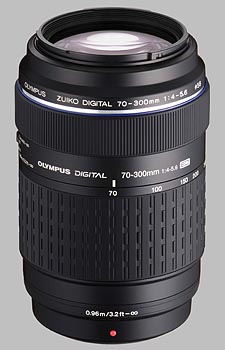
The Olympus 70-300mm Æ’/4-5.6 was released in 2007, offering Olympus four-thirds users an impressive 140-600mm focal length range in a smallish (21oz) package.
The lens is designed to fit the four-thirds sensor, and won’t work on older Olympus film bodies. With an adapter, it can work on micro four-thirds bodies. This lens isn’t a “constant” lens, in that as you increase the focal length, the maximum aperture size decreases, though the minimum aperture remains the same. The following table reflects the changes:
| Focal length | 70mm | 100mm | 149mm | 202mm | 300mm |
| Max. aperture | Æ’/4 | Æ’/4.1 | Æ’/4.5 | Æ’/5 | Æ’/5.6 |
| Min. aperture | Æ’/22 | Æ’/22 | Æ’/22 | Æ’/22 | Æ’/22 |
These figures just correspond to the focal lengths marked on the lens; in actual usage, the widest aperture adjusts quite precisely in conjunction with the focal length setting. As you zoom in and out at the widest aperture, you can see the aperture changing in one-tenth increments.
The lens comes with a circular-styled hood, takes 58mm filters, and is available now for approximately $360.
Sharpness
The lens is nicely sharp, especially when used at 150mm and below, even wide open. Above that, our copy became slightly soft and uneven (it looks like our sample was slightly de-centered).
Used wide open, the lens fared well: at 70mm and Æ’/4, the average sharpness is in the 1.5 blur unit range, with very slight corner softness in the top right, around 2 blur units. Stopping down offers marginal improvements, until it reaches its maximum sharpness for 70mm at Æ’/8. It’s a similar story at 100mm and 150mm – good wide open, best stopped down – though at 100mm, the lens does surprisingly well wide open at Æ’/4.1, at under 1.5 blur units, flat across the frame. There’s not much improvement at 100mm when stopped down.
Above 150mm, the lens becomes slightly soft. Again, our copy shows slight de-centering with a soft spot at the lower right corner of the frame. At 200mm and Æ’/5, there is just a tiny sweet spot of sharpness in the center of the frame in the 1.5 blur unit range, and all else is 2-3 blur units; at 300mm and Æ’/5.6, it’s even worse, with a valley of 2-3 blur units ranging to edges of 4-6 blur units. Stopping down at these focal lengths does go a long way to improving sharpness: at Æ’/11, 200mm produces 1.5-2 blur units, and at Æ’/16, 300mm produces roughly 3 blur units across the frame.
Performance fully stopped-down is average, though again the lens shines a bit more strongly at 100mm, where even at Æ’/22 we see 2.5 blur units across the frame. In summary, if you want a default focal length with which to use this lens, it could be 100mm.
Chromatic Aberration
Chromatic aberration results are quite low for this lens, at 200mm and lower. At 200mm and 300mm we note significant CA in the corners, mostly when used wide open, and improving as the lens is stopped down. But at 150mm and wider, CA is practically imperceptible.
Shading (”Vignetting”)
Corner shading is not really an issue with this lens. When used wide open at any focal length, the lens produces images with corners that are a quarter-stop dark than the center. At any other setting, corner shading is negligible.
Distortion
The lens is nicely optimized to produce almost distortion-free images. At 70mm distortion is essentially zero, and as the lens is zoomed in to 150mm-200mm we see some slight pincushion distortion in the corners (-0.25%), but that’s about as bad as it gets.
Autofocus Operation
The Olympus 70-300mm Æ’/4-5.6 uses an electrical focusing system, focusing the lens from infinity to closest focus in around one and a quarter seconds. We’ve noted this about Olympus lenses before: broad strokes happen slowly, where as small changes in focus seem to happen much more quickly. The focus motor makes very little noise when focusing, and the front element doesn’t turn while focusing.
We did have some inconsistencies regarding autofocus that are worth mentioning; the lens and camera had a hard time auto-focusing on our test charts and still life scenes, requiring manual focus to get results in the right ball park. In ”real life” scenarios the camera / lens performed just fine; the only point here is that our test scenes were more than usually challenging for this particular camera / lens combination. Your mileage may vary.
Macro
The lens isn’t marketted as a macro lens, but it has comparatively good macro abilities, offering 0.5x magnification (1:2 reproduction ratio) and a minimum close-focusing distance of 96cm (3.1 feet) when using manual focus.
Build Quality and Handling
The 70-300mm Æ’/4-5.6 is solidly built. It still seems to be finished with a fair number of plastic parts, but at 620 grams (just over 21 ounces), there’s a lot of glass and metal under the shell. The lens mount is metal, compared to the plastic of less expensive Olympus glass. The fit and finish of this lens is superb; there zoom and focus rings rotate with a velvety smoothness, and the textures have an excellent traction. The only switch on the lens enables or disables autofocus; there are no scales for depth-of-field or distance marked on the lens.
The zoom ring is one-and-a-half inches wide, composed of a hard rubber and made up of a texture of rectangluar extrusions. A turn of around 90 degrees on the zoom ring covers the entire focal range, and extends the overall length of the lens by over two inches at 300mm. The lens has just the right amount of stiffness to prevent zoom creep, but is still fairly fluid to use.
The manual focusing ring is slightly smaller, just over a half-inch in width, and it’s composed of deep ribs, making it easy to distinguish from the zoom ring. The focus ring has a lot of ”turning room” for manual focusing control, and there are no hard stops in this focus range – you can just keep turning the dial.
Unfortunately, mounted 58mm filters will rotate during focus operations, making polarizing filters just that little bit more difficult to use. The lens ships with the LH-61E lens hood, a circular-shaped, bayonet-mounted hood that adds 2 1/2 inches to the overall length of the lens. The hood reverses to mount on the lens for storage and is deeply ribbed on its interior to help prevent flare.
Alternatives
At the time of writing, there isn’t a lot to choose from in this range, making the Olympus 70-300mm the only game in town for its price range.
Olympus 50-200mm Æ’/2.8-3.5 Zuiko Digital ~$1,000
The 50-200mm doesn’t offer the same 300mm range, but it does offer a sharper image with a faster maximum aperture speed. Chromatic aberration and corner shading results are about the same, though there’s a bit more distortion on the 50-200mm. The price tag is significantly higher on the 50-200mm, and the lens is much larger and heavier.
Sigma 135-400mm Æ’/4.5-5.6 DG APO ~$500
Sigma has configured a small selection of its lens for the four-thirds mount, and if telephoto distance is what you’re after, this could be a good alternative. We haven’t yet tested this lens, but if you’re in the market for an effective field of view of 270-800mm, this could be worth your consideration.
Sigma 50-500mm Æ’/4-6.3 EX DG HSM APO ~$1,000
The ”Bigma” has been a popular choice for Olympus 4/3 users, offering an effective 100-1000mm focal length. We’d be comparing apples to oranges in any attempt to compare the 70-300mm to the 50-500mm, as we tested it on another platform. But some searching around the net has found that with the image stabilization of the Olympus camera, using this lens with relatively slow shutter speeds produces very good results. The sticker price is substantially higher than the 70-300mm, but until Olympus comes out with something longer than 300mm, this is the only alternative.
Conclusion
For the time being, four-thirds users looking for an economical telephoto zoom are limited to this lens; third-party manufacturers haven’t chosen to offer their 70-300mm designs to the four-thirds mount. That said, for the money, the Olympus 70-300mm Æ’/4-5.6 offers good results for sharpness, particularly under 150mm and especially at 100mm. CA, corner shading and distortion are also well-controlled, making this a very good deal for the money – provided you’re not buying this lens for its performance at 300mm.
Sample Photos
The VFA target should give you a good idea of sharpness in the center and corners, as well as some idea of the extent of barrel or pincushion distortion and chromatic aberration, while the Still Life subject may help in judging contrast and color. We shoot both images using the default JPEG settings and manual white balance of our test bodies, so the images should be quite consistent from lens to lens.


As appropriate, we shoot these with both full-frame and sub-frame bodies, at a range of focal lengths, and at both maximum aperture and Æ’/8. For the ”VFA” target (the viewfinder accuracy target from Imaging Resource), we also provide sample crops from the center and upper-left corner of each shot, so you can quickly get a sense of relative sharpness, without having to download and inspect the full-res images. To avoid space limitations with the layout of our review pages, indexes to the test shots launch in separate windows.