
LaCie Rugged SSD4 – We Freeze, Drop, Soak, and Drive Over This “Adventure-Proof” Device

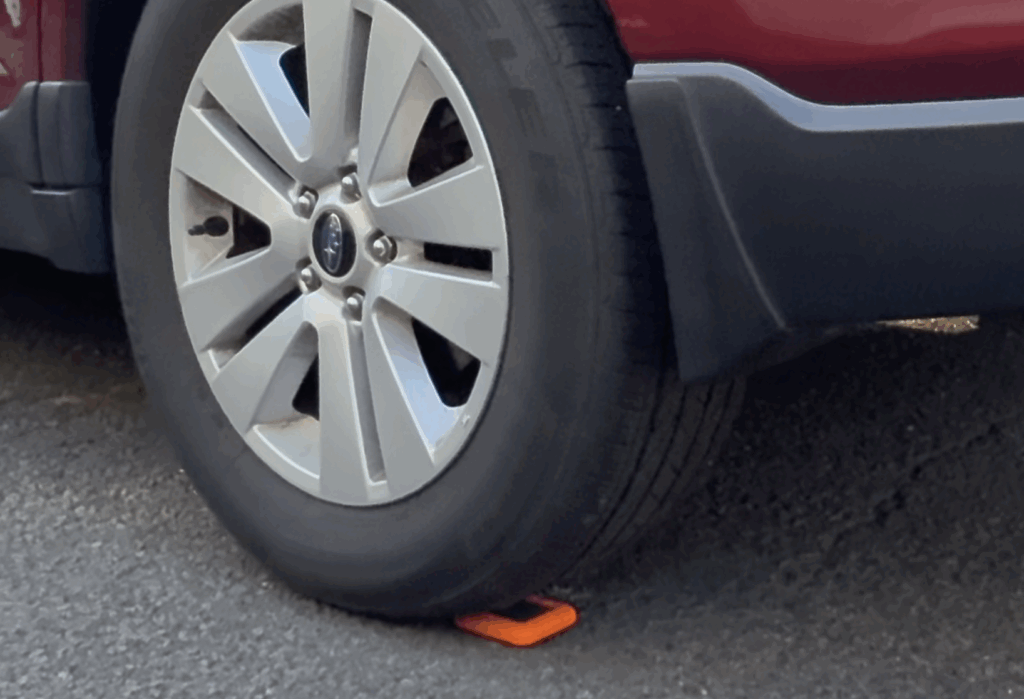
Table of Contents
 Watch our YouTube Review

The LaCie Rugged SSD4 is a high-performance portable SSD engineered for creators on the move. With USB4/Thunderbolt 5 compatibility delivering up to 4,000 MB/s read and 3,800 MB/s write speeds, and built into a shock-resistant IP54 rated shell that survives 3-metre drops and 1-ton pressure, this drive strikes a premium balance of speed and ruggedness. Available in 1 TB, 2 TB and 4 TB capacities, it arrives ready for multi-platform use (macOS, Windows, iPadOS, Android) and includes a 3-year warranty with data recovery support.
- Fast real-world performance when connected via USB4 or Thunderbolt, making it suitable for 4K/8K workflows and large project transfers.
- Rugged construction with drop, dust, and splash resistance designed for field work.
- Broad device compatibility across macOS, Windows, iPadOS, and Android via USB-C.
- Compact and portable size that’s easy to carry in a kit bag.
- Includes a three-year warranty with data recovery services for added protection.
- Requires a full-bandwidth USB4 or Thunderbolt port to reach maximum performance; slower ports will bottleneck the drive.
- Higher price compared to non-rugged portable SSDs.
- IP54 rating provides splash resistance but not full waterproofing.
- Slightly bulkier than ultra-thin portable SSDs due to the rugged bumper.
- Short included cable may not be ideal for all setups.
Over the years, I have dropped many a hard drive or SSD, and while most of them survived, many of them were gone forever with a sad thud as they hit the floor.
Hard drives were the main culprits for an early death. The spinning platters and mechanics needed to read and write data weren’t designed for sudden deceleration. Nor were they designed to handle water, freezing temperatures, or being crushed.
Portable hard drives were designed to be more durable than their desktop counterparts, but they’re still incredibly delicate devices.
Solid State Drives (SSD) handle these conditions better, but they’re still fragile. Get a drive wet and, well, you’ve got an expensive paperweight. Drive over it with your car, and they’re toast, and of course, you are a bad driver.
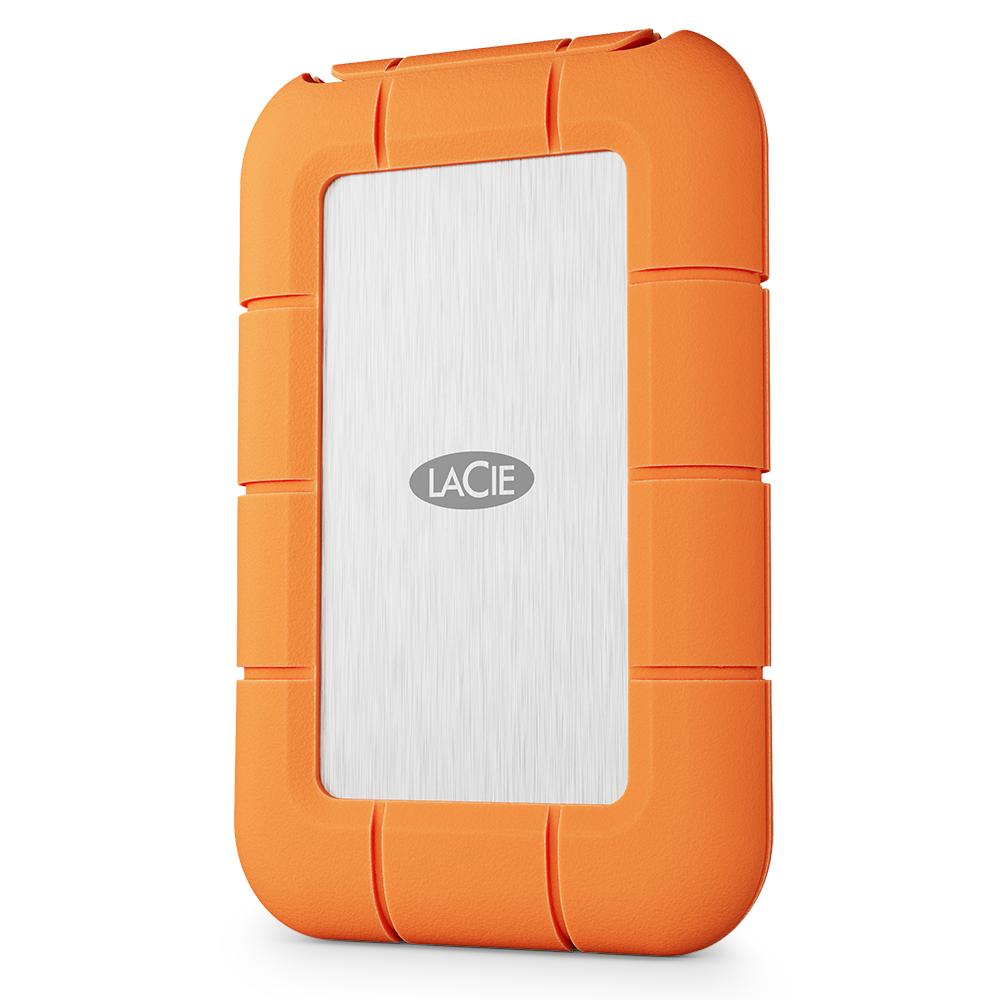
From the dawn of the portable hard drive era, there have been drives designed to be more durable than most. LaCie was one of the first companies to make a rugged portable hard drive. These units are distinct with an orange silicone bumper protecting the drives, and the blaze orange cover makes the drives easier to see when you put them down.
As we shifted from hard drives to SSDs, the durability of portable drives improved, mostly. There are many popular and inexpensive portable drives on the market. But to achieve their low price, they either are not constructed to withstand the elements (or accidents), or they have slow transfer speeds.
Drives designed for durability likewise tend to have slow connectivity because the speed is secondary to the data loss protection they provide. Rugged, fast, or affordable—pick any two.
LaCie claims the Rugged SSD4 is “adventure-proof,” which they say means it is resistant to freezing temperatures, water exposure, drops, and being crushed.
We’ll see about that.
Watch our YouTube Review
To be fair, each of these claims comes with a metric. You can’t drop it from your roof or go scuba diving with it. You shouldn’t put it under an elephant’s foot, and it’s not going to survive a trip to photograph penguins in Antarctica.
More on how we tested these claims is below.
Imaging Resource Buyer’s Guide to SSDs
If you’re looking for more SSD recommendations, check out our buyer’s guide.
LaCie Tackles Durability and Speed in One Orange Package
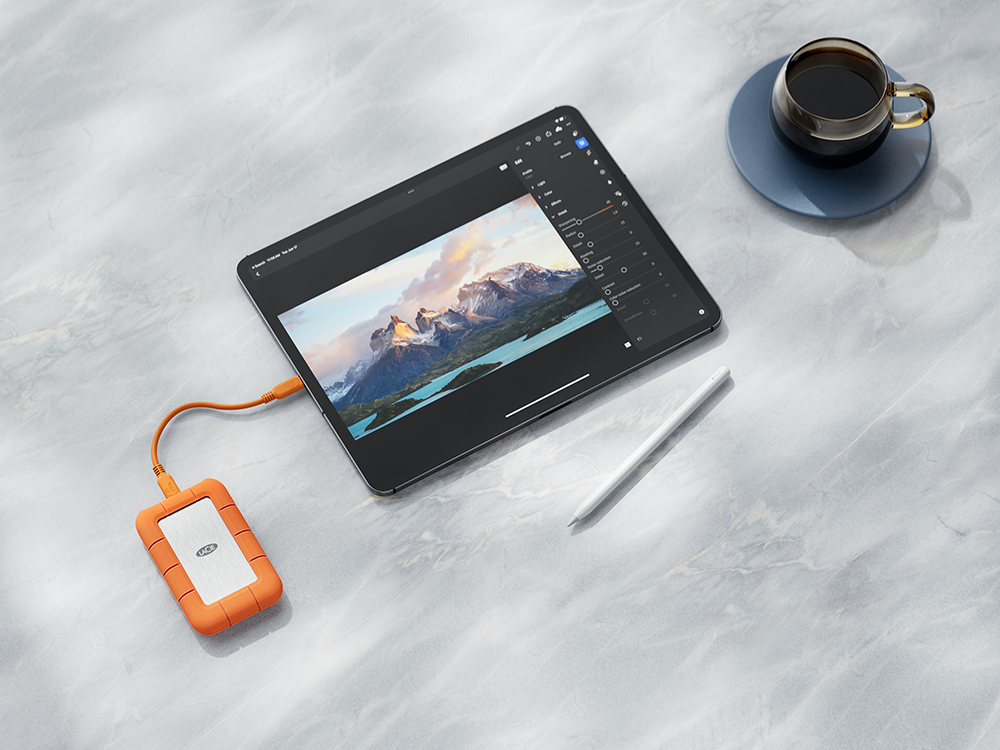
The LaCie Rugged SSD4 manages to nail durability and speed, something not a lot of drives can claim.. With transfer speeds up to 4,000 MB/second, the drives are fast enough to do ProRes 4K 120 recording and editing. If you’re not a video editor, just know that’s incredibly fast, more than fast enough to handle even files from a camera with a 100 megapixel sensor like the Hasselblad X2D II 100 C that we reviewed.
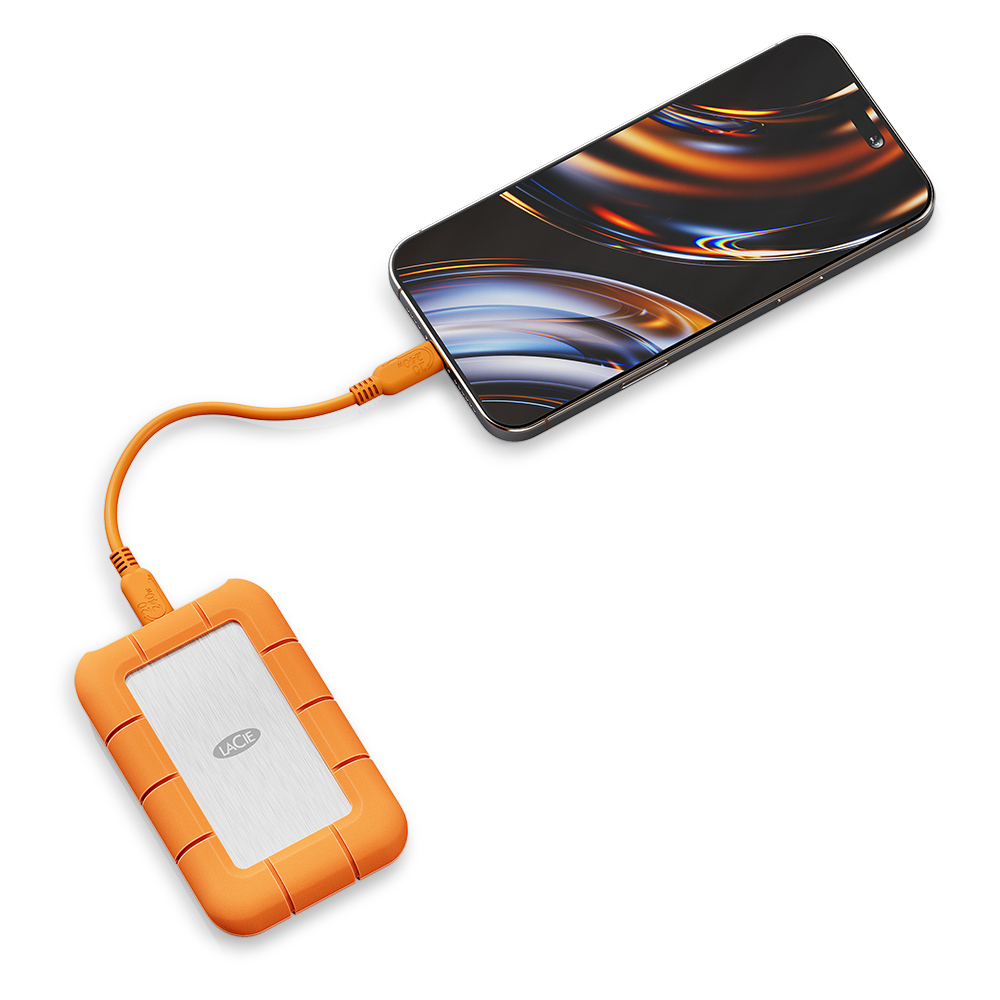
To achieve the speeds provided by the SSD inside the enclosure, the Rugged SSD4 has a USB-C port that handles USB 40Gbps, USB 20Gbps, the older USB 1-Gbps, and the geriatric USB 5Gbps. It also supports Thunderbolt 5, Thunderbolt 4, and Thunderbolt 3.
All of this is to say that you can plug this drive into nearly anything and it will work. Out of the box, it can connect to Macs, iPhones and iPads, Windows machines, Chromebooks, and more.
The Rugged SSD4 has an IP54 rating. A system for quantifying how a device withstands environmental conditions, the “5” means it is not dust-proof, but the amount of dust that can enter won’t degrade performance. The “4” means that it resists water splashed in any direction.
The price is surprisingly competitive. The 1TB model costs $120, the 2TB model $215, and the 4TB model $400. For comparison, the OWC 1.M2 Express we reviewed is $249 for the 1TB unit, $400 for the 2TB drive, the 4TB is $630, and the 8TB $1300.
The reason the OWC is more expensive than the LaCie Rugged SSD comes down to the heat management of the OWC unit. Enclosed in a body that’s basically a large heat sync, the OWC 1.M2 Express should prevent overheating, which is the leading cause of SSD deaths.
So while the LaCie Rugged SSD4 is designed to withstand the elements, the OWC drive is designed to survive long-term high-volume data transfers. The LaCie might also do well for years, but heat management isn’t its goal. Surviving a hurricane is.
LaCie Rugged SSD4 Put to the Test
To test LaCie’s claims of adventure-proofness, we turned to our dedicated and sophisticated hardware evaluation labs and ran multiple calibrated tests.
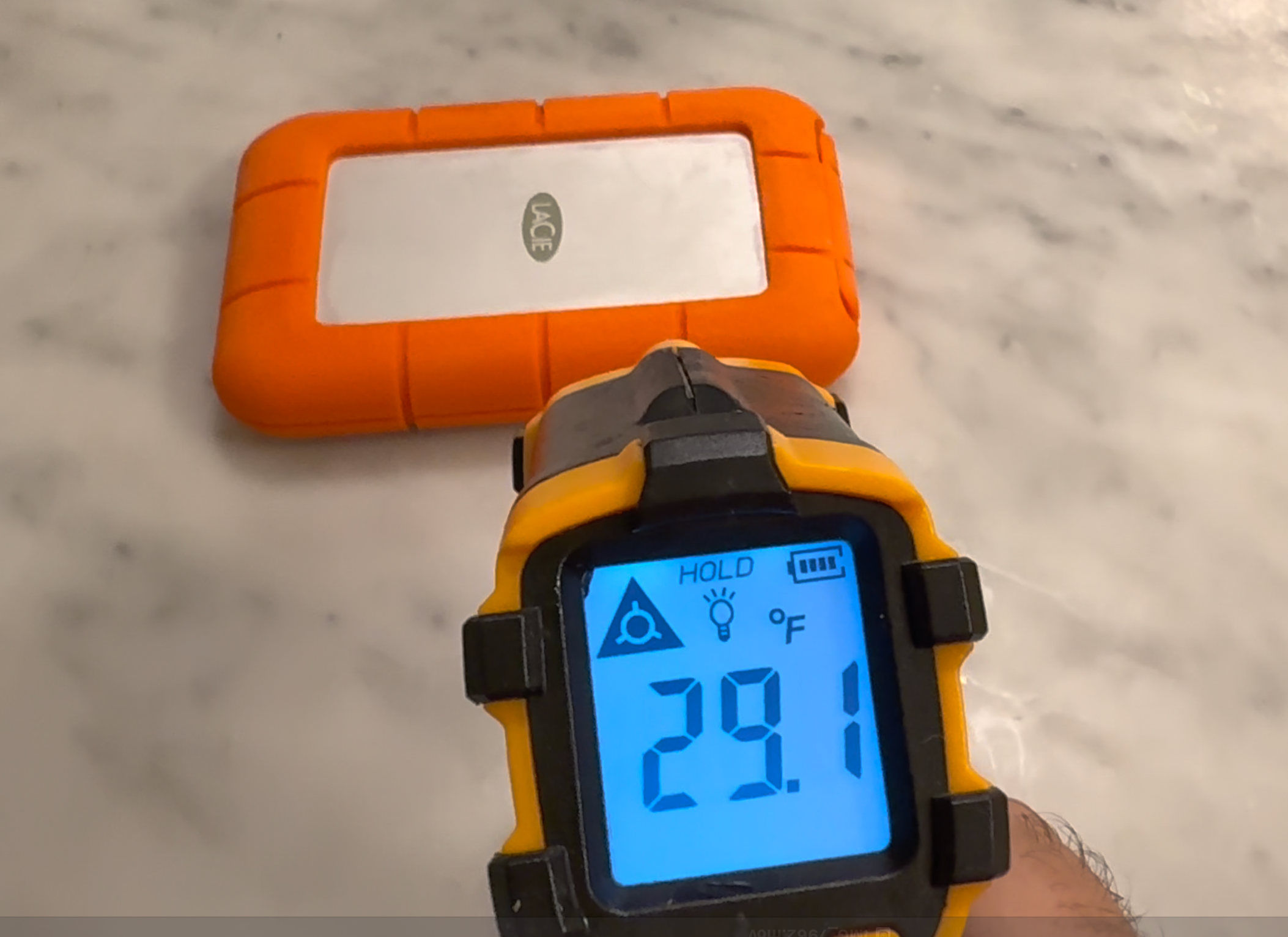
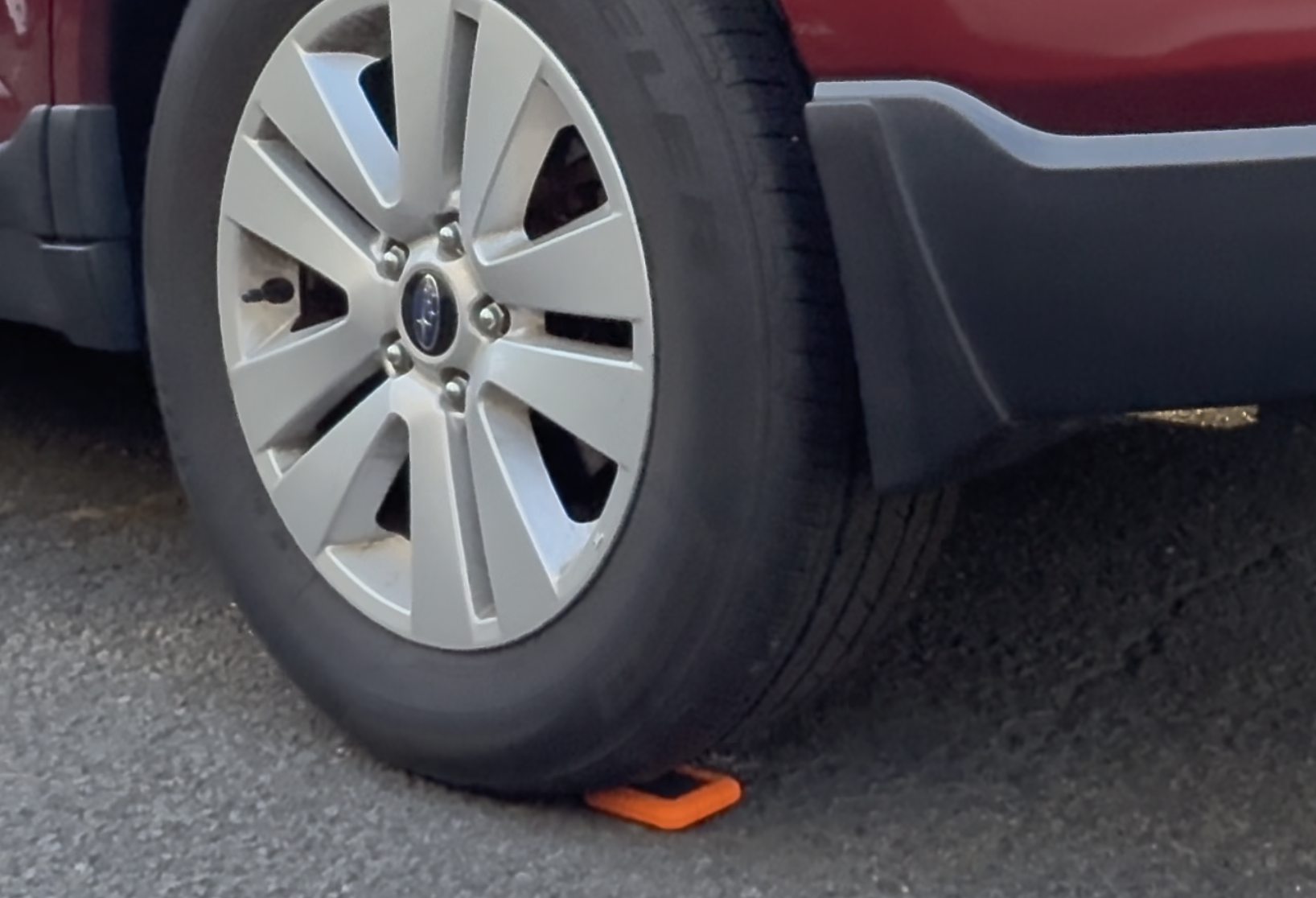
I’m kidding, my son and I took it, threw it in the deep freezer, and then after a day cooling down and thawing out, we took it outside, threw it, sprayed it with a hose, and drove over it with my car several times. It turns out that driving over an SSD is enjoyable, so we did a few passes.
After each torture test, we took it immediately to my Mac and tested the speed, and each time it performed as well as it did right ouf ot the box.
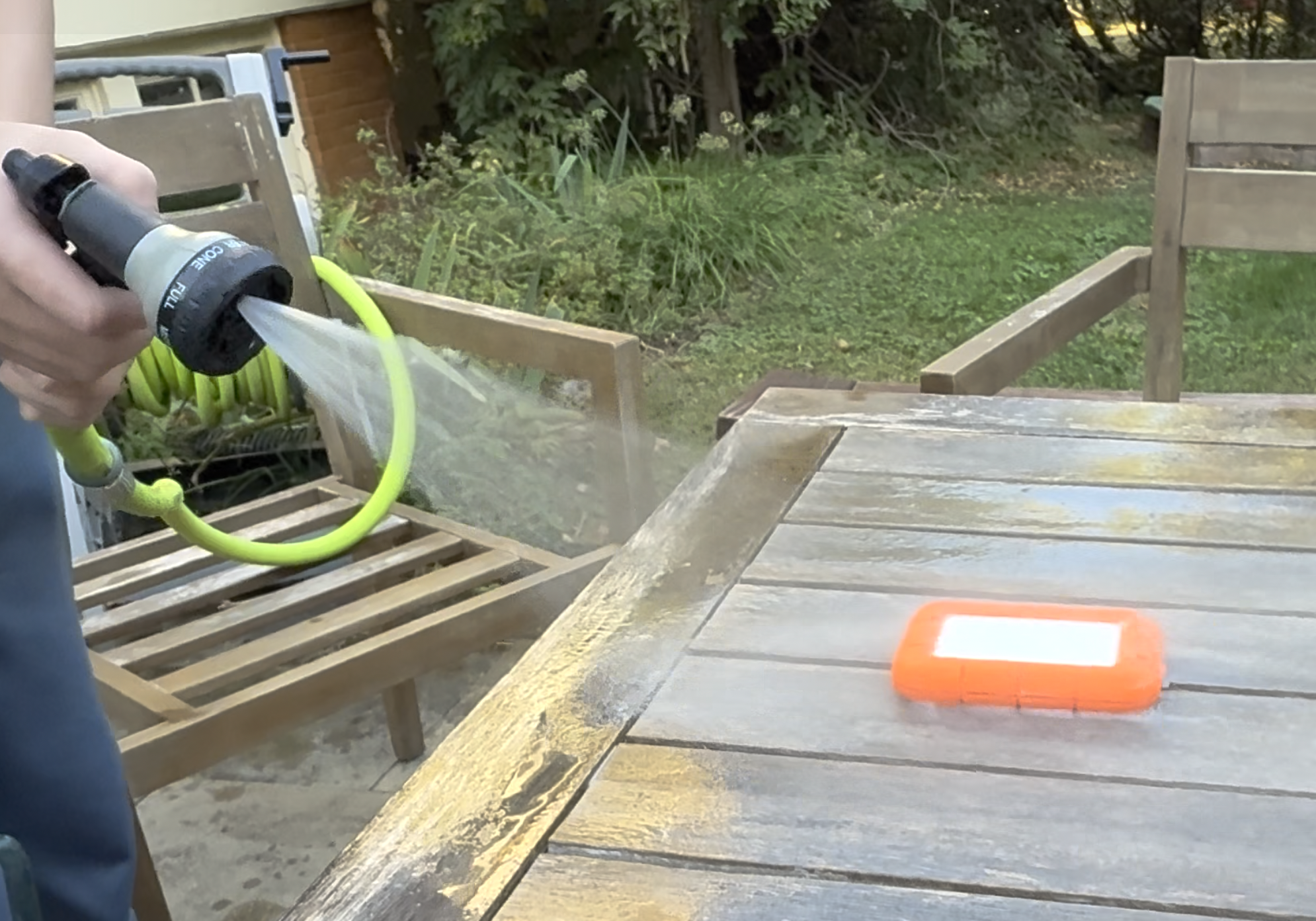
We didn’t adhere to the specs either. We tossed it onto the driveway from a retaining wall about four feet above the ground. We doused it with water from a hose and completely doused it., And, as I said, we drove over it like it was a zombie in The Walking Dead.
Because I was trying to get some slow-motion footage, and because we wanted it to fall a specific way, we ended up throwing it in the air multiple times, with it hitting the driveway repeatedly.

To quote Timex, it took a licking and kept on ticking.
I’ve since put the drive back into service, using it for editing in Resolve.
My one gripe is that the drive comes with a rubber plug to cover the USB-C port, and of course, I lost it not in the process of testing it, but sometime when I had it out to use in a coffee shop or at lunch. I’m not sure which.
While the USB-C port is probably fine without this port, I’m not sure why it doesn’t come with some sort of attachment to the silicone bumper or the drive itself. If you buy this drive, keep an eye on that piece.
Should you buy This Drive?
The LaCie Rugged SSD4 lives up to its claims. Without spending years dropping it, it’s hard to say if it will stand the test of time, but a drive like this isn’t meant to be used indefinitely. At some point, I take all of my drives, load them with archive data, and stick them on a shelf.
Unlike many of my drives, should my shelf collapse, this drive won’t be bothered at all.
If you’re looking for a rugged SSD that has fast connectivity and tested durability, this drive is a perfect choice.