
Ultimate Microphone Buyer’s Guide for Video Creators (2025)

Table of Contents
 Why Great Audio Is Essential
By: David Schloss, Editor-in-Chief and the Imaging Resource Staff
Why Great Audio Is Essential
Most viewers will continue watching a video with mediocre quality if the audio is clear, but even Hollywood-quality footage is abandoned if the sound is poor.
Your microphone choice affects every aspect of your production – from how professional you sound to how much time you’ll spend fixing audio problems later. Whether you’re filming interviews, documentaries, or YouTube tutorials, the right mic makes all the difference.
Our Picks At A Glance
Key Takeaways
Compact shotgun microphones provide a straightforward way to improve audio without complicated setups. By focusing on sound in front of the camera and reducing background noise, they are ideal for run-and-gun shooting where simplicity and clarity matter most.
Wireless lavalier systems are the go-to choice for interviews and moving subjects. They offer flexibility, freedom of movement, and multi-person recording options, making them essential for creators working in dynamic environments.
Studio microphones deliver the highest quality for controlled spaces like podcasts, streaming setups, and voiceovers. The main choice is between dynamic mics, which reject background noise but need strong amplification, and condenser mics, which capture more detail but require a treated room.
Connectivity also plays a big role. XLR microphones generally sound better but need audio interfaces and supporting accessories, while USB models offer quick plug-and-play convenience. Choosing between them depends on whether you value long-term expandability or simplicity.
Modern wireless systems add features like 32-bit float recording, which safeguards against clipping and overly quiet levels. This technology helps creators capture usable audio in unpredictable environments and reduces the need for constant monitoring.
Best Picks By Category
- Shotgun (Budget): Rode VideoMic GO II
- Shotgun (Best Reviewed): Sennheiser MKE 600
- Shotgun (Ultimate): Rode NTG-5
- Wireless (Budget): DJI Mic 3
- Wireless (Best Reviewed): Rode Wireless Pro
- Wireless (Ultimate): Sony UWP-D27
- Studio (Budget): Audio-Technica AT2020
- Studio (Best Reviewed): Shure SM7B
- Studio (Ultimate): Neumann U87Ai
Why Trust Us?
I was formerly the Editor of HDVideo Pro, which focused on audio and video gear for creators in cinema and high-end video production. I have been testing and writing about microphones for eight years, and consulting on YouTube channels since 2010. I create content for both the Imaging Resource YouTube channel and my own channel.
The Imaging Resource team has tested and used microphones in real-world conditions for more than a decade. We’ve recorded in studios, on busy streets, and in planes, trains, and automobiles to see how different mics perform.
Our recommendations are based on hands-on experience with every micrphone in this guide except the Neumann U87Ai. Priced at more than $3000, we’ve only used this mic at tradeshows, but it has a legendary reputation.
Understanding Microphone Types
Lavaliers (Also Known as Lav Mics) are small microphones that clip onto clothing and are ideal for interviews or situations where you want the microphone hidden.
Shotgun mics are long, directional microphones that mount on cameras or boom poles. They focus on sounds in front while minimizing background noise, though they need to be pointed accurately at the sound source.
XLR Mics are professional microphones that connect via three-pin XLR cables to audio interfaces or recorders. They offer the best sound quality but require additional equipment.
USB Mics plug directly into computers or smartphones, making them convenient for podcasters and streamers.
Shotgun Microphones
These directional mics attach directly to your camera or smartphone, capturing clear audio while rejecting noise from the sides and rear. Perfect for situations where you can’t wire up your subject with a lavalier mic, and where background noise would ruin the audio from your built-in microphone.
Budget: Rode VideoMic GO II

.
This mic stays in my camera bag permanently, and I break it out when I’m using my iPhone to record, thanks to the USB-C connector. With the included USB-C to microphone adapter, you can also use this on any camera.
This lightweight shotgun mic is perfect for beginners and dramatically improves the audio quality of your camera or smartphone compared to its built-in mic. The supercardioid pattern focuses on what’s in front of the camera while reducing background chatter.
If you’re using it with a phone, you’ll want to pick up a phone cage with a tripod mount. Our favorite is the SmallRig Universal Phone Cage.
Who is this for?
Creators who want a simple, lightweight on‑camera mic with USB flexibility.
- Super light and compact for on‑camera use
- Dual output: 3.5mm TRS or USB‑C for direct-to-computer/phone
- No battery required; plug‑in power or bus‑powered
- Great value for beginners
- No onboard gain/filters
- Picks up handling noise without a shock mount
- More room noise than longer shotguns
- Type: Compact shotgun (supercardioid)
- Connectors: 3.5mm TRS analog, USB‑C digital (class‑compliant)
- Power: Plug‑in power (3.5mm) or USB bus‑power
- Frequency Response: 20 Hz-20 kHz
- Dimensions: ~150 mm x Ø22 mm (5.9 x Ø0.87 in)
- Weight: ~89 g (0.20 lb)
- Included: Foam windshield, cold‑shoe mount
Best: Sennheiser MKE 600
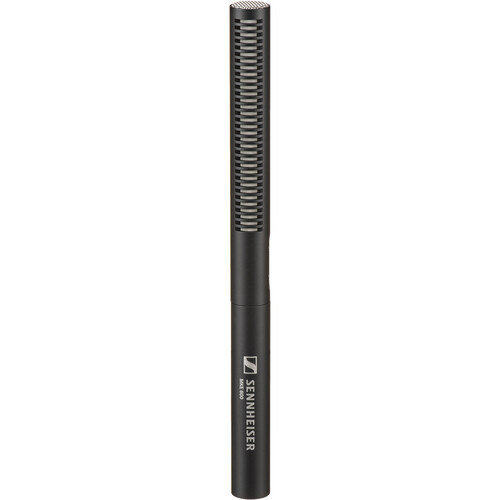
A professional-grade shotgun mic that delivers broadcast-quality audio. It’s especially effective in noisy environments due to its excellent side noise rejection. The MKE 600 can be powered by battery or phantom power, making it versatile for different setups.
I’ve used this mic to cover product launches and create footage in noisy environments, and it produces a great sound.
Rating: 4.7
Pros
- Strong directionality and off-axis rejection
- Runs on AA battery or 48V phantom
- Switchable low-cut to tame rumble
Cons
- Requires XLR cabling/interface
- Heavier and longer than compact shotguns
- Requires battery power; if your battery runs out, the mic stops working.
Specs
- Type: Shotgun (supercardioid/lobar)
- Connection: XLR-3M
- Power: 48V phantom or 1x AA battery
- Freq. response: 40 Hz-20 kHz (low-cut at ~100 Hz)
- Dimensions: 256 mm x Ø20 mm (10.1 x Ø0.79 in)
- Weight: ~128 g (0.28 lb)
- Included: Shock mount, foam windshield
Who is this for?
Anyone who needs a reliable camera-top shotgun mic.
Ultimate: Rode NTG-5
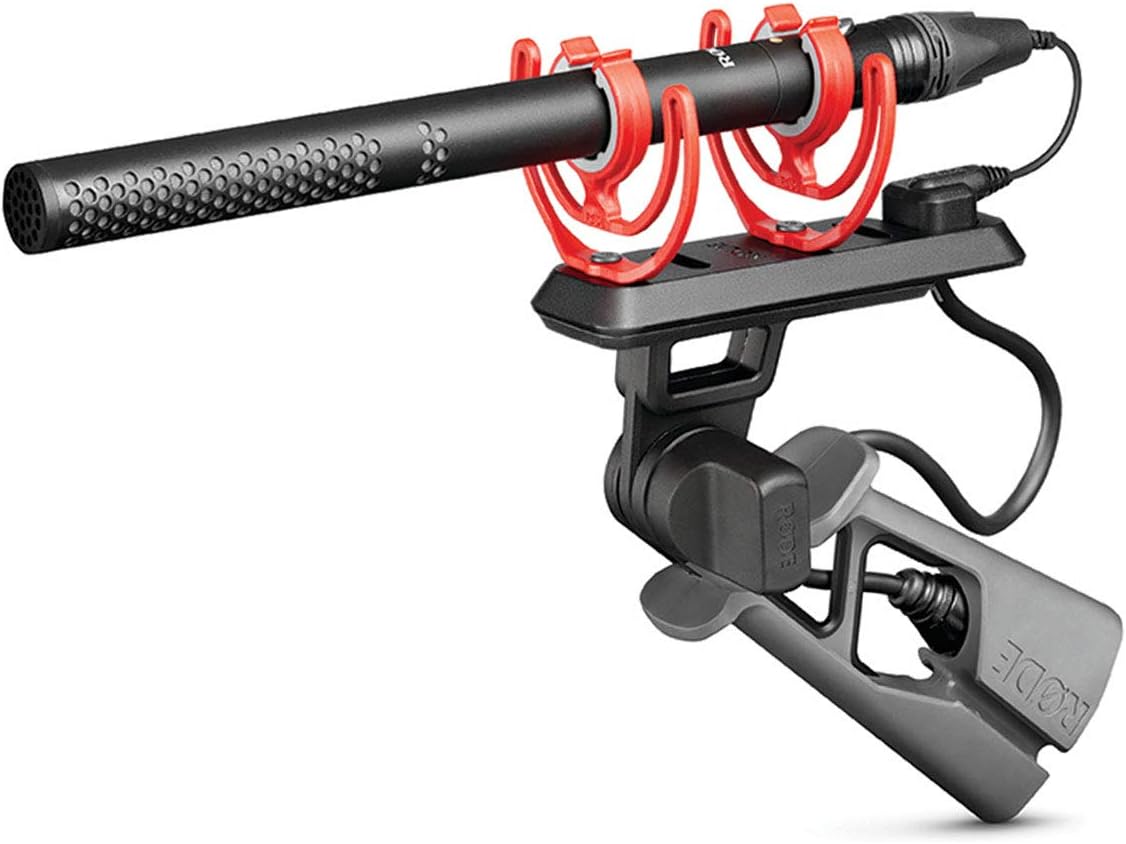
The gold standard for serious filmmakers, this shotgun mic captures incredibly detailed, nearly perfect audio. Its rugged, weather-resistant design makes it ideal for outdoor shooting, and the included shock mount eliminates handling noise. This is the mic of professionals, but it creates spectacular audio for any creator.
Rating: 4.7
Pros
- Ultra-low self-noise (~10 dBA) with RF-bias design
- Very light and weather-resistant; excellent off-axis rejection
- Pro kit includes windshield, pistol grip, and cables
Cons
- Pricey compared to mid-range shotguns
- Requires 48V phantom power, which needs to be provided by your camera.
Specs
- Type: Professional shotgun (supercardioid)
- Connection: XLR-3M
- Power: 48V phantom
- Self-noise: ~10 dBA (very low)
- Freq. response: 20 Hz-20 kHz
- Dimensions: 203 mm x Ø19 mm (8.0 x Ø0.75 in)
- Weight: ~76 g (0.17 lb)
- Included: WS10 windshield, PG2-R grip (kit-dependent)
Who is this for?
Shooters who want a lightweight flagship shotgun for boom or camera-mount use, and need the best audio possible in this class.
Note: Sony, Canon, and several other manufacturers make microphones that connect digitally over their multi-purpose hotshoe. These mics generally produce excellent audio quality, but the microphones above sound better than most of these options. Check with your manufacturer’s website to see if a digital microphone is available.
Wireless Microphone Systems
Wireless systems give you freedom of movement while ensuring clean audio. And that’s essential for interviews, presentations, or any situation where your subject needs to move around.
The digital transmission of these top-of-the-line wireless microphones means no more crackling or lost audio.
Budget: DJI Mic 3
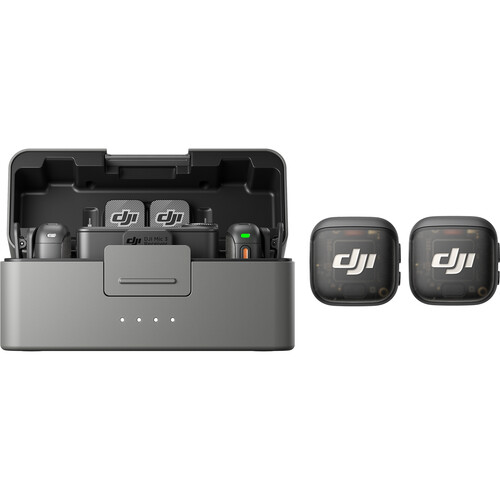
The DJI Mic 3 is a new update to the legendary DJI Mic 2, which creators have relied on for years, and which I’ve used on countless shoots.
A significant update, the DJI Mic 3 has improved on nearly every aspect of operation. The tiny microphones and receiver fit into a case with a built-in battery, allowing the gear to be charged simultaneously.
The system can now handle up to eight mics and multiple receivers with no problems. The microphones have 32-bit float to prevent clipping or low-volume audio. Each microphone features internal recording, which resolves the issue of lost audio if the receiver fails. Internal audio allows you to record without needing the receiver, and you can then sync the audio later.
As someone who isn’t big on advertising unless someone sponsors me, I’m only disappointed that it has a large DJI logo on the front. But some black electrical tape solved that problem for me.
Rating: 4.5/5
Pros
- Compact and lightweight transmitters (~16 g each), ~50% smaller than Mic 2
- Extended battery life: ~8 hrs for TX, ~10 hrs for RX, and up to 28 hrs total with charging case
- Vastly improved transmission range: up to 400 m
- 32 GB onboard storage per transmitter (vs. 8 GB in Mic 2)
- Advanced audio features: Adaptive Gain Control, two-level noise cancellation, and three voice tone presets
- Pro-level support: timecode synchronization and support for up to 4TX + 8RX multi-camera setups
- Includes sleek, modular charging case that stores accessories like magnetic clips and deadcats
Cons
- No 3.5 mm lavalier input on transmitters (a staple in Mic 2)
- Menus and features may mean a learning curve for beginners.
- Strong noise cancellation mode may introduce low-frequency distortion in specific vocal ranges.
- Some reviewers note the receiver’s touchscreen can be slightly finicky.
Specs
- Weight (per transmitter): ~16 g with magnet
- Weight (receiver): ~25.1 g
- Battery life: TX = 8 hrs, RX = 10 hrs, Charging Case = ~28 hrs (2.4 full charges)
- Wireless range: up to 400 m
- Onboard storage: 32 GB per TX; supports 24-bit & 32-bit float recording; dual file backup
- Audio formats: 24-bit/48 kHz and 32-bit float; includes timecode support.
- Antenna: 2.4 GHz / 5 GHz band hopping for a stable signal
- Adaptive Gain Control: Automatic and Dynamic Modes
- Noise Cancellation: Two levels (Basic & Strong)
- Voice Tone Presets: Regular, Rich, Bright
Who is this for?
Content creators who want one of the most compact and feature-packed wireless audio systems that offer pro-level features, but are smaller and more affordable than professional gear.
Best: Rode Wireless Pro
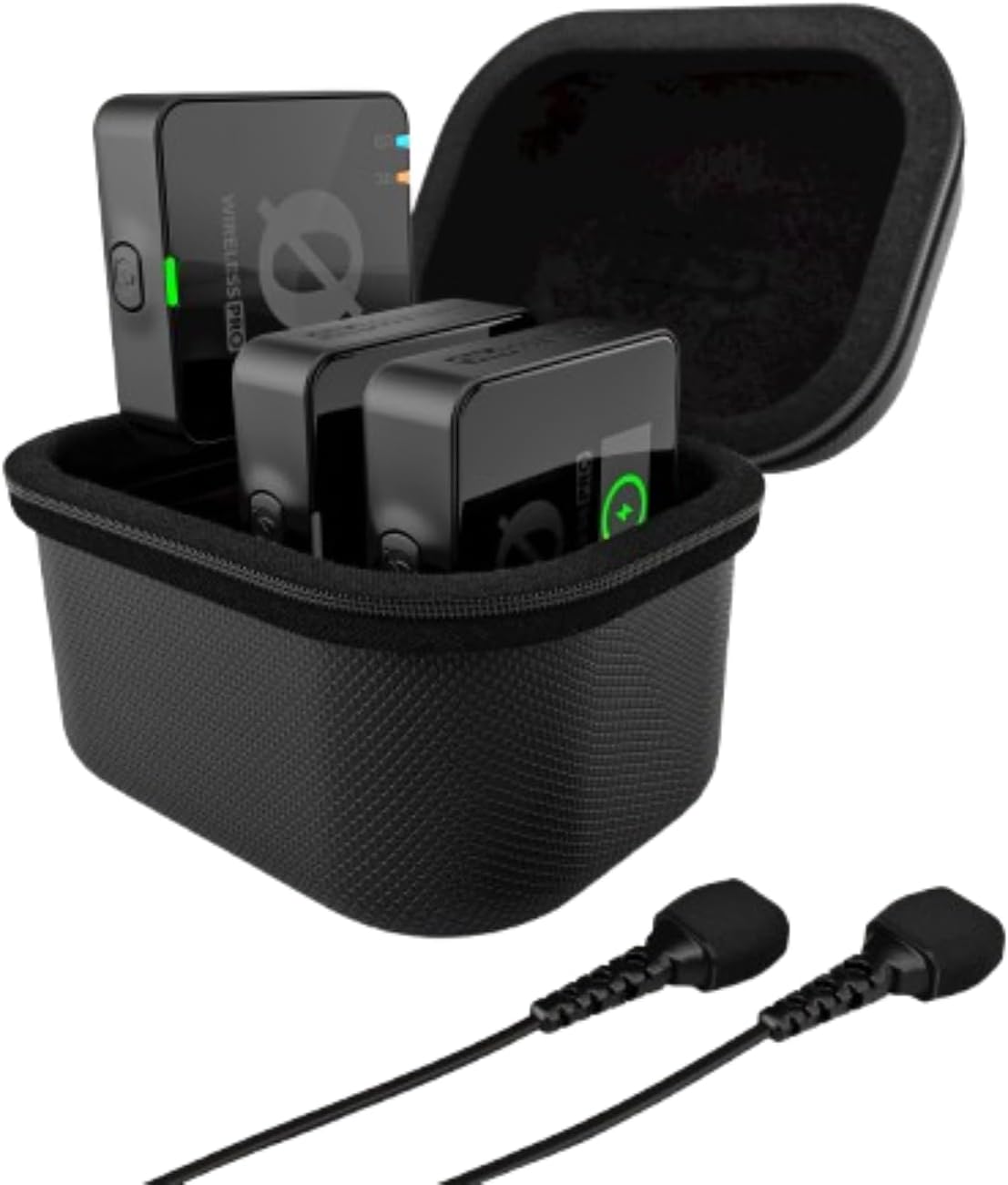
This mic used to be the go-to system for professional creators, though the new DJI Mic 3 levels the playing field somewhat. RODE is known for its audio excellence, and this system is no exception.
The mic and receiver setup live inside a battery-powered case, for one-cable charging. Audio is 32-bit float and is the clearest I’ve heard in my tests.
The Rode Wireless Pro can be used as a stand-alone microphone or can connect to a lavalier microphone, which is included with the mic.
Rating: 4.7
Pros
- Dual-channel system with on-transmitter 32-bit float recording
- Timecode sync support and GainAssist auto-leveling
- Locking 3.5mm lav connectors improve reliability
Cons
- Pricier than most 2-channel kits
- Learning curve to master all features
Specs
- Type: 2.4 GHz digital wireless (dual TX + RX)
- Range: Up to ~260 m (line-of-sight)
- Recording: 32-bit float internal (TX), 48 kHz / 24-bit output
- I/O: 3.5mm TRS, USB-C digital; analog out to camera
- Battery: ~7 hours; chargeable in case
- Features: Timecode, GainAssist, onboard storage
Who is this for?
Creators who need a robust 2-person kit with broadcast-safe backups and features like timecode.
Ultimate: Sony UWP-D27
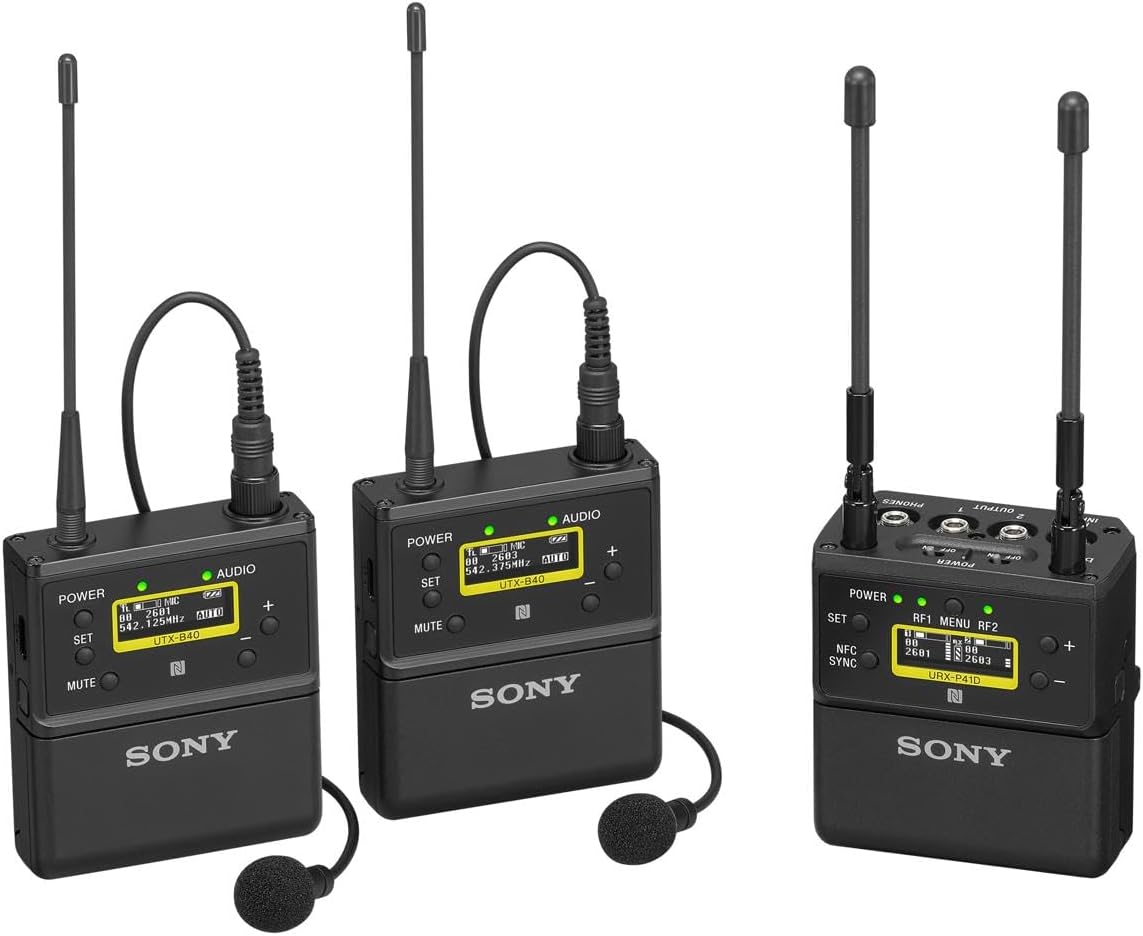
Broadcasters and film crews rely on this system for its rock-solid UHF transmission, which works effectively through walls and over long distances. The included lavalier mic sounds fantastic, and the system supports timecode sync for professional workflows.
Rating: 4.8
Pros
- Pro UHF system
- NFC Sync and MI-Shoe digital audio for compatible Sony cameras
- Excellent RF reliability in congested venues
Cons
- Significantly more expensive than 2.4 GHz kits
- Bulkier receiver than compact mirrorless-oriented systems
Specs:
- Type: UHF wireless (URX-P41D dual RX + two UTX-B40 TX)
- Tuning: Wide bandwidth (region-dependent)
- Outputs: XLR / 3.5mm; MI-Shoe digital audio via SMAD-P5
- Power: AA batteries; long runtime
- Features: True diversity, auto-gain, IR/NFC sync
Who is this for?
Broadcast and event teams that prioritize rock-solid RF and direct-to-camera digital audio on Sony bodies.
Studio Microphones
For voiceovers, podcasts, streaming, and controlled recordings, studio mics capture the richest, most natural sound. Unlike lav and wireless microphones, you don’t have to wear them on your clothes. The audio from a studio microphone is superior to even the best shotgun microphone.
Budget: Audio-Technica AT2020
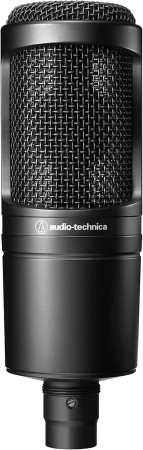
A great first studio mic that delivers surprisingly good sound for the price. You’ll notice this mic on many smaller YouTube channels. The cardioid pattern focuses on your voice while reducing room noise, and it works with both USB and XLR connections, allowing you to use it regardless of your recording setup.
Rating: 4.5/5
Pros
- Clean, detailed sound at a very low price
- Lightweight and simple; great first XLR condenser
Cons
- Requires 48V interface; picks up room reflections
- No onboard controls or shock mount included
Specs
- Type: Large-diaphragm condenser (cardioid)
- Connection: XLR
- Power: 48V phantom
- Freq. response: 20 Hz-20 kHz
- Max SPL: ~144 dB
- Dimensions: 162 mm x Ø52 mm (6.4 x Ø2.0 in)
- Weight: ~345 g (0.76 lb)
Who is this for?
Streamers and talking head channels who want studio clarity on a tight budget.
Best: Shure SM7B
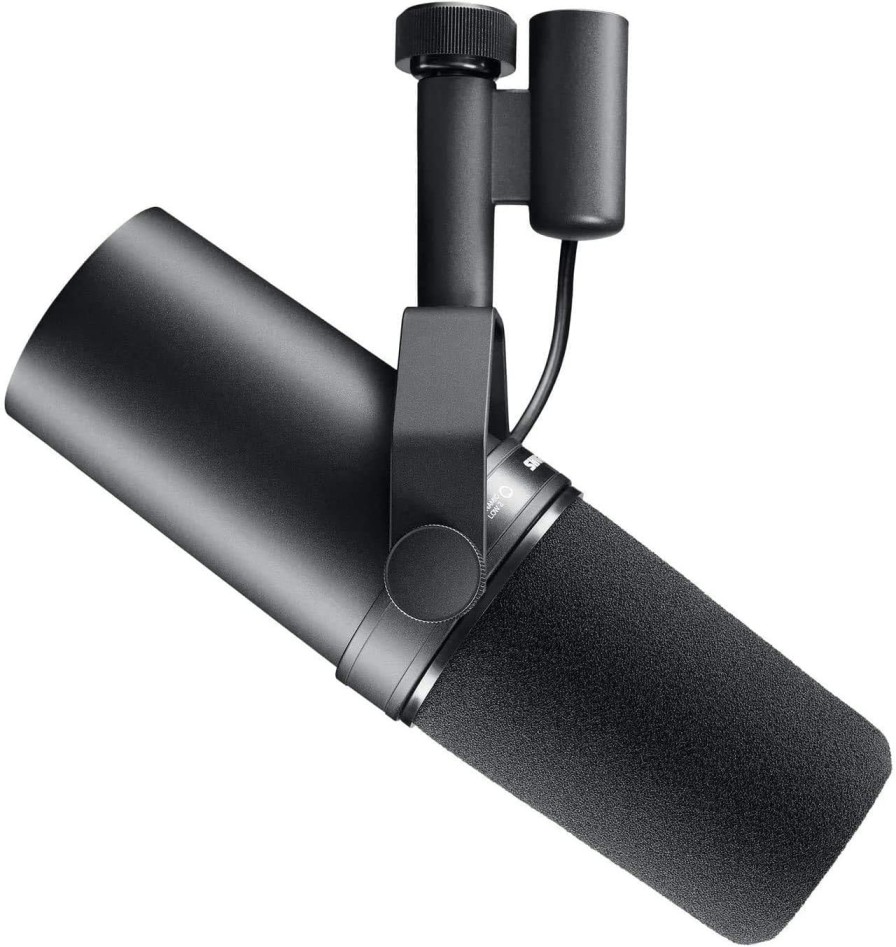
This legendary microphone is used in professional radio stations and podcasts worldwide. If you listen to NPR, you’ve heard this mic dozens of times. Its smooth, warm sound flatters all voice types, and the built-in pop filter reduces plosives (those annoying “p” and “b” sounds). Unlike many studio mics, it rejects background noise exceptionally well.
To get the best sound possible from this mic requires some tweaking. Fans of this mic appreciate the process of customizing their setup, while new users may find it challenging.
I have this in my studio, though I often go back and forth between this and the Logitech Blue Sona depending on the audio characteristics I’m looking for.
Rating: 4.9/5
Pros
- Iconic broadcast tone with superb plosive rejection
- Excellent background noise rejection for untreated rooms
Cons
- Very low output; benefits from a gain booster/Cloudlifter
- Heavier and large; requires sturdy boom arm
Specs
- Type: Dynamic (cardioid)
- Connection: XLR
- Freq. response: 50 Hz-20 kHz (switchable presence/low-cut)
- Sensitivity: ~-59 dBV/Pa
- Weight: ~765 g (1.69 lb)
Who is this for?
Podcasters and streamers who want the classic radio sound and work in less-than-ideal rooms.
Runner-Up: Logitech Blue Sona
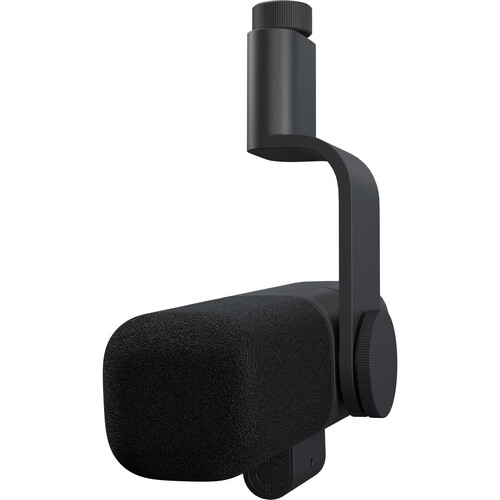
In addition to using the Shure SM7B in my studio, I have also used the Logitech Blue Sona microphone. It’s slightly less expensive than the Shure, but I’ve found the audio quality to be very similar to that of the Shure. The SM7B has a warmer tone, which is why it’s used in many radio stations and on podcasts. However, the Logitech has built-in filter controls to help shape the sound.
Rating: 4.7/5
Pros
- Clear, professional sound right out of the box
- Built-in ClearAmp provides ample volume without requiring additional gear.
- Strong build and modern design
Cons
- Needs an audio interface to connect (not USB)
- Bulkier than some mics
- Higher price than entry-level options
Specs
- Type: Dynamic supercardioid broadcast microphone
- Frequency response: 40 Hz – 18 kHz
- Sensitivity: -50 dBV/Pa (without ClearAmp), -25 dBV/Pa (with ClearAmp engaged)
- Max SPL: ~129 dB
- Built-in preamp: ClearAmp (+25 dB gain, requires 48V phantom power)
- Output: Balanced XLR
- Weight: ~615 g (1.36 lbs)
- Dimensions: 147 x 65 x 65 mm (5.8 x 2.6 x 2.6 in)
- Included accessories: Two windscreens, adjustable yoke mount
Who is this for?
People who want their voice to sound rich and professional without needing extra gear. Perfect for podcasters, streamers, or anyone seeking exceptional audio quality with a straightforward setup.
Ultimate: Neumann U87Ai
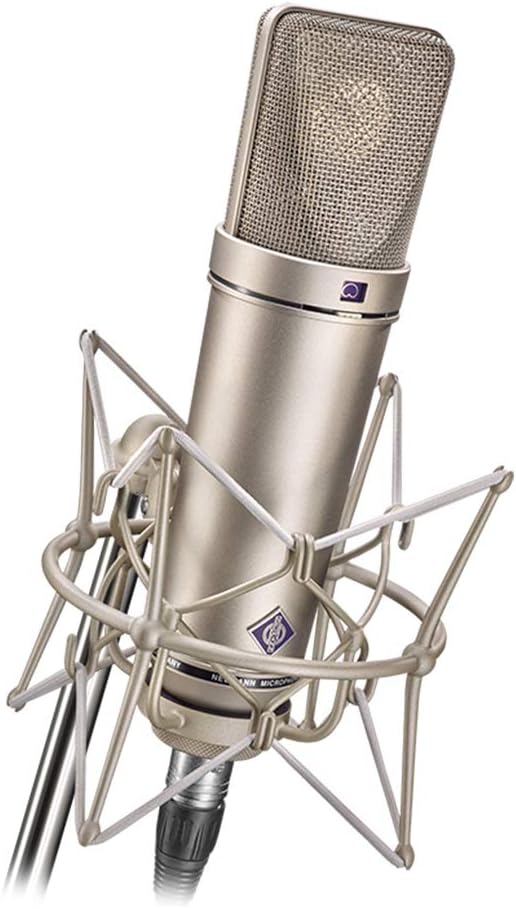
The industry standard for professional audio recording studios, this mic captures incredibly detailed vocals with perfect clarity. Its three polar patterns let you record anything from solo vocals to group discussions with stunning quality.
Rating: 4.9
Pros
- Gold-standard large-diaphragm condenser with three selectable polar patterns
- Silky, detailed sound for vocals, narration, and instruments
- Highly versatile for both studio voice and music recording
Cons
- Extremely expensive compared to most studio mics
- Very sensitive to room acoustics – needs proper treatment
- Requires a high-quality preamp/interface and pop filter to shine
Specs
- Type: Large-diaphragm condenser microphone
- Polar patterns: Cardioid, omnidirectional, figure-8
- Frequency response: 20 Hz – 20 kHz
- Switches: -10 dB pad, low-cut filter
- Connection: XLR (requires 48V phantom power)
- Max SPL: ~127 dB (137 dB with pad)
- Self-noise: ~12 dBA
- Weight: ~500 g (1.10 lbs)
- Dimensions: 200 x 56 mm (7.9 x 2.2 in)
Who is this for?
Studios, professional voice actors, and high-end creators who want a buy-it-for-life microphone that delivers world-class sound for voice, podcasting, narration, and music recording.
Comparison Chart
| Product | Category | Type/Pattern | Connectivity | Notable Features | Weight | Power | Best For |
|---|---|---|---|---|---|---|---|
| Rode VideoMic GO II | Shotgun | Compact shotgun (supercardioid) | 3.5mm TRS, USB-C | USB mode, plug-in power | ~89 g | Plug-in/USB bus | Run-and-gun vlogging |
| Sennheiser MKE 600 | Shotgun | Shotgun (supercardioid/lobar) | XLR-3M | Low-cut, battery/phantom | ~128 g | AA or 48V | Film/doc on boom/camera |
| Rode NTG-5 | Shotgun | Pro shotgun (supercardioid) | XLR-3M | RF-bias, 10 dBA self-noise | ~76 g | 48V phantom | High-end documentary/film |
| DJI Mic 3 | Wireless | 2.4 GHz digital lav system | 3.5mm/TRS, USB-C | 32-bit float backup, ANC | ~16 g (TX) | Rechargeable | Solo interviews/vlogging |
| Rode Wireless Pro | Wireless | 2.4 GHz dual-TX kit | 3.5mm/TRS, USB-C | 32-bit float, timecode | ~32 g (TX) | Rechargeable | Two-person shoots |
| Sony UWP-D27 | Wireless | UHF dual-channel | XLR, 3.5mm, MI-Shoe | True diversity, NFC Sync | Receiver ~120 g | AA batteries | Broadcast/events |
| Audio-Technica AT2020 | Studio | Condenser (cardioid) | XLR | Lightweight, affordable | ~345 g | 48V phantom | VO/streaming on budget |
| Shure SM7B | Studio | Dynamic (cardioid) | XLR | Broadcast tone, filters | ~765 g | No phantom (needs gain) | Podcasting/streaming |
| Logitech Blue Sona | Studio | Dynamic supercardioid | XLR | ClearAmp preamp, filters | ~615 g | 48V phantom | Podcasting/streaming |
| Neumann U87Ai | Studio | Condenser (multi-pattern) | XLR | 3 patterns, pad/low-cut | ~500 g | 48V phantom | Pro voice, music |
FAQ
Do I really need an external microphone for video production?
Yes, if you want professional-quality audio. Most viewers will continue watching a video with mediocre picture quality if the audio is clear, but even Hollywood-quality footage is abandoned when the sound is poor. Built-in camera and smartphone microphones lack directionality, pick up camera handling noise, and capture excessive background sound. Even an entry-level external microphone like the Rode VideoMic GO II dramatically improves audio quality compared to built-in options.
What’s the difference between shotgun, wireless, and studio microphones?
Shotgun microphones are directional mics that mount on cameras or boom poles, focusing on sounds directly in front while minimizing background noise-perfect for film and video production. Wireless lavalier systems use small clip-on mics that attach to clothing, ideal for interviews and situations requiring freedom of movement. Studio microphones deliver the richest, most natural sound for controlled environments like voiceovers, podcasts, and streaming, but require proper positioning on stands or boom arms and work best in acoustically treated spaces.
Should I choose XLR or USB connectivity?
XLR microphones typically sound better and offer more flexibility for professional workflows, but they require an audio interface to connect to computers along with supporting accessories like boom arms and shock mounts. USB microphones plug directly into computers for immediate use, making them convenient for podcasters and streamers who prioritize simplicity. If you plan to grow your setup over time or need the highest possible quality, XLR provides a more future-proof foundation despite the additional equipment requirements.
What is 32-bit float recording and do I need it?
32-bit float recording technology, available on wireless systems like the DJI Mic 3 and Rode Wireless Pro, provides enormous dynamic range that prevents both clipping from loud sounds and unusably quiet recordings. This acts as a safety net for unpredictable shooting scenarios where audio levels change dramatically-you can fix levels in post-production without quality loss. For creators working in controlled studio environments, this feature matters less, but for field recording, interviews, and documentary work, it can save takes that would otherwise be unusable.
What is phantom power and do I need it?
Phantom power is 48-volt electricity supplied through XLR cables to power condenser microphones and some active equipment. Many audio interfaces and recorders provide phantom power via a switch, while battery-powered options like the Sennheiser MKE 600 can run on either phantom power or AA batteries. Dynamic microphones like the Shure SM7B don’t require phantom power but need substantial gain from your audio interface or a dedicated preamp like the Cloudlifter to achieve proper recording levels.
How do I choose between dynamic and condenser studio microphones?
Dynamic microphones like the Shure SM7B reject room noise and focus tightly on the speaker, making them ideal for untreated rooms and environments with background sound, though they require substantial gain from your interface. Condenser microphones like the Audio-Technica AT2020 or Neumann U87Ai capture more detail and nuance, delivering richer, more professional sound, but they pick up room reflections and require acoustically treated spaces. For most home studios without professional treatment, dynamic mics provide better results despite their gain requirements.
What accessories do I actually need with my microphone?
Essential accessories depend on your microphone type and shooting environment. Shotgun mics benefit from windscreens or deadcats for outdoor recording and shock mounts to reduce handling noise. Studio mics require shock mounts to isolate vibrations, pop filters to reduce plosive sounds, and boom arms for flexible positioning. XLR microphones need appropriate cables and an audio interface like the Focusrite Scarlett 2i2 or Elgato Wave XLR. Wireless systems typically include most necessary accessories in the kit, though additional deadcats for outdoor use often prove worthwhile.
What’s better for outdoor recording-wireless lavs or shotgun mics?
Both serve different purposes outdoors. Wireless lavalier systems excel when subjects move around and you need consistent audio regardless of camera distance. Shotgun mics work better for stationary interviews or when you can control the boom operator’s position and maintain proper mic-to-subject distance. For maximum flexibility in unpredictable outdoor situations, having both options available lets you adapt to changing conditions. Always use proper wind protection-foam windscreens for light breeze, fuzzy deadcats for stronger wind conditions.
Can I use my microphone with both cameras and smartphones?
Many modern microphones offer multiple connectivity options. The Rode VideoMic GO II, for example, provides both 3.5mm TRS output for cameras and USB-C for direct smartphone connection. Wireless systems like the DJI Mic 3 include multiple output options including 3.5mm TRS, USB-C, and Lightning adapters. For XLR microphones, you’ll need an audio interface that connects to your recording device. Always verify compatibility with your specific camera or smartphone model before purchasing.
Do expensive microphones really sound that much better than budget options?
Premium microphones like the Neumann U87Ai deliver objectively superior sound quality with lower self-noise, better frequency response, and more accurate reproduction, but the difference matters most in professional contexts where clients expect broadcast-quality audio. For YouTube content, podcasts, and most video work, mid-range options like the Shure SM7B or Rode NTG-5 provide excellent quality at a fraction of the cost. Investing in proper accessories, acoustic treatment, and recording technique often improves results more than upgrading from a good microphone to a great one. Start with equipment that matches your current needs and upgrade as your skills and requirements grow.
Glossary
Pop Filter – A screen placed in front of a microphone to reduce popping sounds from plosive consonants like “P” and “B.”
Shock Mount – A suspension system that isolates the microphone from vibrations and handling noise.
Latency – The short delay between speaking into a microphone and hearing the sound playback. USB mics often have built-in headphone jacks for low-latency monitoring.l