
Pentax 645Z Review

Updates:
08/20/14: First Shots posted!
08/21/14: Performance results posted!
09/02/14: Gallery sample photos posted!
09/11/14: Field Test Blog Part I: Ricoh’s mighty medium-format takes on the mile-high city
10/08/14: Field Test Blog Part II: Straying outside of the medium-format comfort zone
10/09/14: Image Quality Comparison and Print Quality Analysis
10/27/14: Conclusion posted!
Back in early 2010, Pentax launched the 645D, a medium-format digital SLR that it had been developing for the previous five years. It might have been a long time coming, but it was nonetheless exciting for it. The 645D leapfrogged rivals Canon, Nikon and Sony with two-thirds greater sensor area than a full-frame sensor, yielding a unique look and shallower depth of field. At the same time, it was vastly more affordable than offerings from medium-format makers like Hasselblad and Phase One, yet rugged enough to be used in the field.
The reason Pentax — since taken over by Ricoh — could offer its camera at a more attractive price-point than other medium-format products was pretty simple. Much of the design work for the 645D could be shared with the company’s mass market, APS-C DSLRs, where Hasselblad and Phase One — neither of which sells consumer SLRs — had to bear the entire cost of development solely with their medium format products.
While Pentax lacked (and indeed, still lacks) a full-frame DSLR, the 645D served both as an aspirational model for the enthusiasts to look up to, and as something genuinely different to attract pros for whom that resolution and medium-format look was more important than high-speed capture. And boy, did it ever offer a lot of resolution by 2010 standards. (In fact, it’s only recently that we’ve started to see cameras with smaller sensors catching up.) When we first put the 645D in our lab, we were amazed to find that it picked up details we’d never even noticed in our test scenes — details that we couldn’t even see with our own eyes, until we pulled out a magnifying glass to confirm them.

Just like the medium-format film cameras in whose footsteps it followed, the 645D was never going to be a mass-market camera. Medium-format is an even smaller niche than it was in the film days, but the 645D was nonetheless a very important camera for the company, and its followup — the Pentax 645Z — is no less important.
Just like its predecessor, the Pentax 645Z shares much with Ricoh’s flagship APS-C DSLRs — and with four years of development having taken place on the APS-C front since the 645D was launched, there was no shortage of new features for it to inherit. But the most important feature of them all is at its very heart, a brand-new, Sony-sourced 51-megapixel CMOS image sensor. It’s coupled to a PRIME III image processor, as first seen in the K-3, and the 645Z also inherits that camera’s 27-point SAFOX 11 autofocus and 86,000 pixel RGB metering systems.
The 645Z’s new image sensor allows a spectacularly wide sensitivity range, especially by medium-format camera standards, covering everything up to ISO 204,800 equivalent. It also provides both live view and Full HD movie capture capabilities, neither of which its predecessor was capable of. And performance has taken a big step forwards, at least compared to other medium-format cameras. This still isn’t a sports shooter, but it’ll shoot at almost triple the speed of the 645D. You’ll also be able to review photos post-capture in less than half the time.

Nor do the improvements stop there. The Pentax 645Z sports a larger, tilting LCD panel with higher resolution, an improvement that’s doubly useful given the new live view function. And its shutter life has been doubled to 100,000 shots, giving you a lot more photos across which to spread the cost of your camera purchase.
Pentax has also gifted its new medium-format camera with the K-3’s support for high-speed USB 3.0 SuperSpeed transfer and UHS-I compatible Secure Digital cards, as well as the clever Pentax-badged (but rather unappealingly-named) Flucard, which allows remote live view and remote control via Wi-Fi. And like the K-3, you can also shoot 4K interval movies with the 645D. These won’t include sound, but Full HD movies will capture stereo audio either with an onboard mic or an external one, complete with automatic or manual levels control. And the list of new features goes on, as you’ll find out in our Technical Info section. Let’s take a closer look at the 645Z.
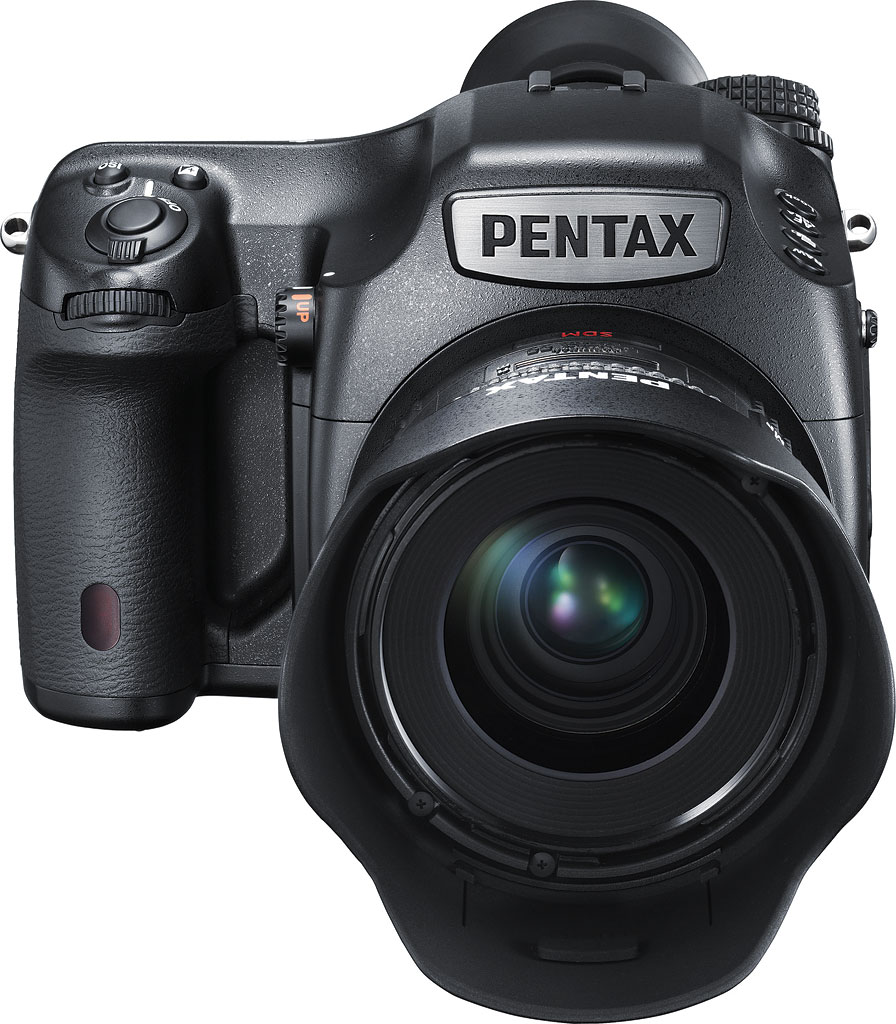
Walkaround. Seen from the front, the Pentax 645Z looks a whole lot like its predecessor, the 645D. In fact, the most notable difference is the brand-new, silver badge on the front of the viewfinder prism housing, which used to be black. Look a little beyond the surface, though, and this is clearly a new body. It’s grown in depth by a tenth of an inch (4mm) and in weight by 2.5 ounces (71g), neither of which will be noticeable in the real world. Like its predecessor, this isn’t a small camera — but it’s also not as large as you might think it from the photos.
In terms of height and width, the Pentax 645Z differs little from typical full-frame cameras like the Canon EOS 5D Mark III or Nikon D800. It’s actually a little bit narrower and a fair bit shorter than professional cameras like the Canon EOS 1D X or Nikon D4S, in large part because it doesn’t have a portrait grip.

Where the 645Z loses out in the comparison is in its depth and weight. The medium-format sensor that pays dividends in other areas needs a much larger mirror box, so as to provide room for the reflex mirror to swing aside before each exposure. That extra depth — around 1 to 1.5 inches more than the 1D X and D4S — is greatest at the lens mount, rather than the hand grip, giving the 645Z a chunky, blocky aesthetic. Weight is about a quarter more than the D4S (and similar to that of the 1D X), at 54.7 ounces (1,550g) loaded and ready to go.
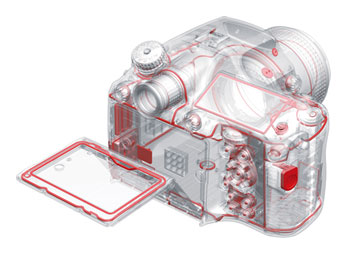
But that’s a small price to pay for a sensor that’s about two-third larger in terms of surface area than a 35mm full-frame sensor. And on the plus side, it also gives the Pentax 645Z plenty of room for external controls that have been designed for use even with gloved hands. That’s something you’ll appreciate if you take advantage of its freezeproof design. It’s also weather-resistant and dustproof, with 76 seals throughout, just like its predecessor.
And there’s little question that this is a pro-grade body, either. It has a die-cast aluminum chassis beneath a magnesium-alloy exterior shell — not a hint of polycarbonate in sight.

Seen from above, there are a few differences between the Pentax 645Z and the earlier 645D. There are three new User modes on the Mode dial, replacing the single mode of the earlier camera and making it easy to access multiple settings groups that you’ve configured ahead of time. The line of buttons down the left side of the body have also been tweaked, with the SD buttons replaced by AF Area and Lock buttons, and the order changed to move the Bracketing Mode button forwards. There’s also a new stereo microphone whose two ports straddle the sides of the viewfinder prism housing, and a two-hole speaker a little further back on the right side of the housing.

Moving to the rear of the 645Z, you’ll find the majority of the changes — and they’ve largely been made to accommodate the new LCD monitor. It’s both larger at 3.2 inches in diagonal, and adds a tilting mechanism for viewing over the head, at waist-level, or low to the ground.
The row of buttons that previously sat beneath the display are gone, with their four functions assumed by the arrow buttons of the four-way controller. The same buttons are also used to adjust the autofocus point location, courtesy of the same AF point button seen previously in the Pentax K-3. (This control also doubles as the card selection button in playback mode.)
The column of buttons that used to line the right of the LCD, meanwhile, have become a square cluster at the base of the camera’s right rear. One of these, the Delete button, also gets a second purpose as a Movie Record button when the camera is in Movie mode. And since AF point selection is now achieved elsewhere, the dial to the right of the viewfinder that previously served this function now acts as a dedicated Still / Movie control dial.

Looking at the left of the left side of the 645Z’s body, the standard-definition composite video output has been removed, and in its place is a new 3.5mm stereo microphone jack. The remaining ports under the same rubber flap are much the same, although the USB port is now a USB 3.0 SuperSpeed type, and the arrangement of the ports has changed. Note that there are also still two Secure Digital card slots under the door that sits above the connectivity compartment, and these are now UHS-I card compatible.

And finally, we move to the right side of the camera body, where there’s but one change of note. The wired remote control terminal, previously found under a flap on the rear of the body, now sits in the handgrip. It’s a logical move, given the lack of space elsewhere. If you’re shooting with a remote, you’re not going to need to hold the grip, after all.
And that about does it for the Pentax 645Z’s physical changes. Let’s take a look at what’s inside the camera!