
Sony A7S Review


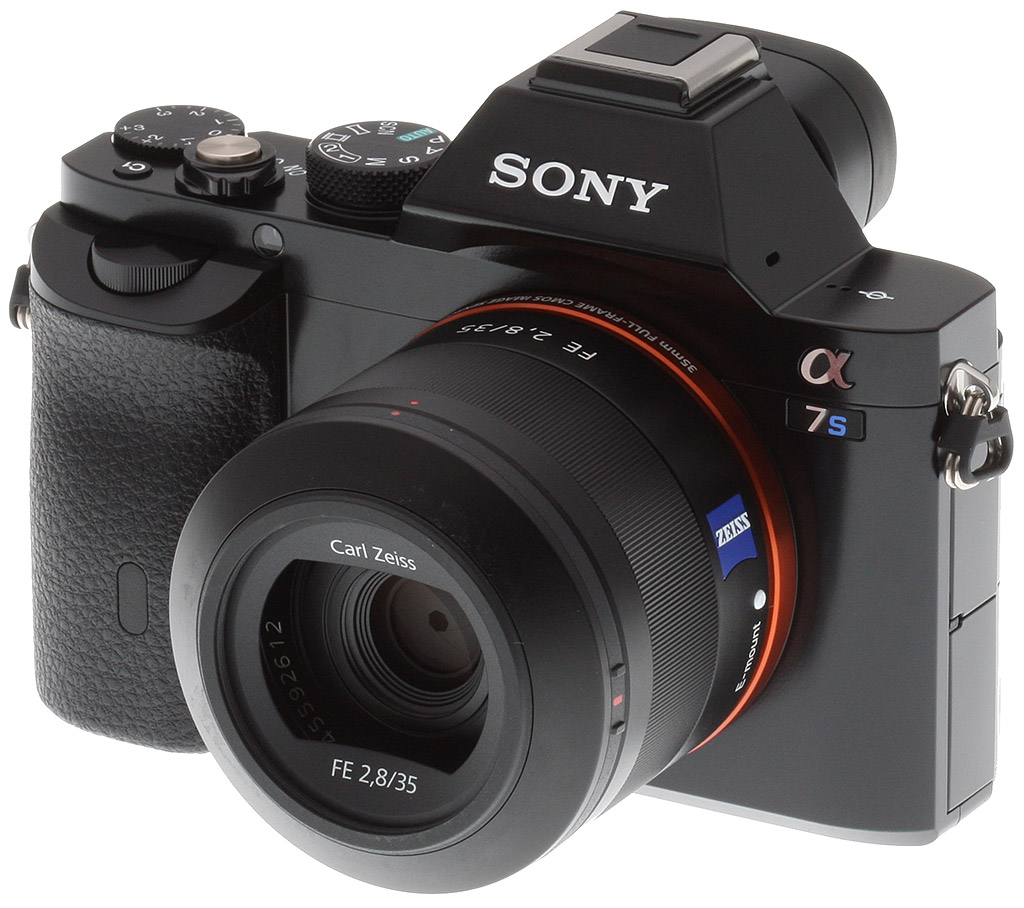
Table of Contents
 Sony A7 Field Tests
Updates:
04/09/2014: Added Sony A7S vs. A7R/A7 comparison table
05/16/2014: Added pricing and availability info
08/26/2014: Field Test Part I –
First impressions, handling and oh my, high ISO!
10/27/2014: Field Test Part II – Dynamic Range Performance & Video Recording
11/07/2014: Image Quality Comparison and Print Quality Analysis
12/12/2014: Review-wrap and final Conclusion posted
Sony really redefined what full-frame photography could be in the fall of 2013, with the introduction of the A7 and A7R, by far the smallest full-frame, fully-featured interchangeable lens cameras we’d seen to date. Now, the Sony A7S is poised to similarly redefine the world of 4K video and low-light still shooting.
Rather than chasing ever more pixels, the Sony A7S takes a conscious step back, featuring an all-new 12.2-megapixel sensor with huge pixels — by current standards, at least — as well as some unique tweaks aimed at increasing dynamic range. The combination equates to unprecedented low-light performance. By default, the Sony A7S has a sensitivity range of ISO 100 to 102,400 equivalents for still imaging or video. This range can be expanded for still shooting to encompass everything from ISO 50 to 409,600 equivalents in still shooting, and ISO 100 to 409,600 equivalents for video.
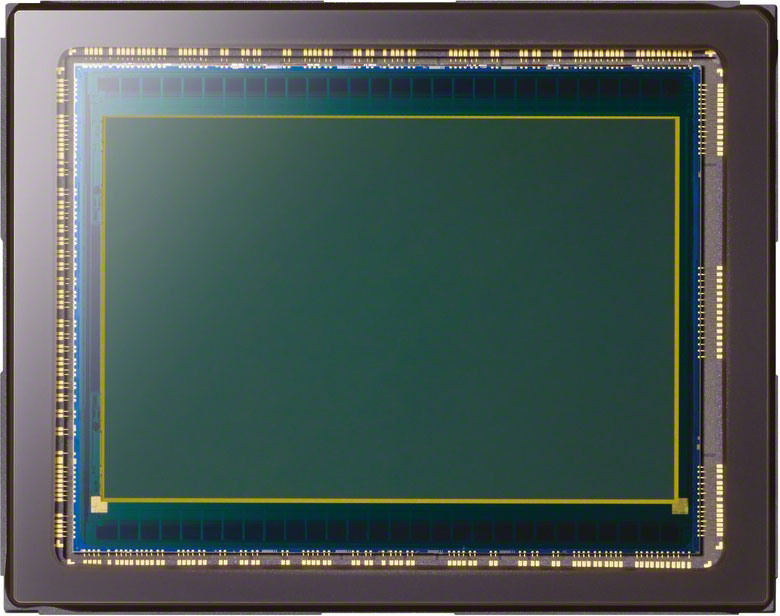
While we saw a similar ISO range from the Nikon D4s, the Sony A7S’s bigger pixels and special sensor architecture offers lower noise levels and better detail — albeit at a lower resolution.
There’s some new sensor technology at play in the Sony A7S, beyond just its bigger pixels. We were told that the A7S sensor can, with some paraphrasing, “adjust its gain corresponding to its environment. It essentially adjusts its dynamic range accordingly, so that it is able to optimize the dynamic range for each ambient environment, whether dark, bright, harsh lighting, etc.”
That’s intriguing, but doesn’t really tell us much about how it actually works. However Sony did say that it expects a dynamic range of up to 15.3 stops from the A7S in raw format.
Another important feature for the A7S is the ability to use a Silent Shooting mode. This allows fully-silent shooting with both electronic first and second-curtain functions, not simply a reduced noise level with electronic first-curtain and mechanical second-curtain, as in some competing cameras.This is a huge feature for nature shooting, or any other environment in which silence is key.
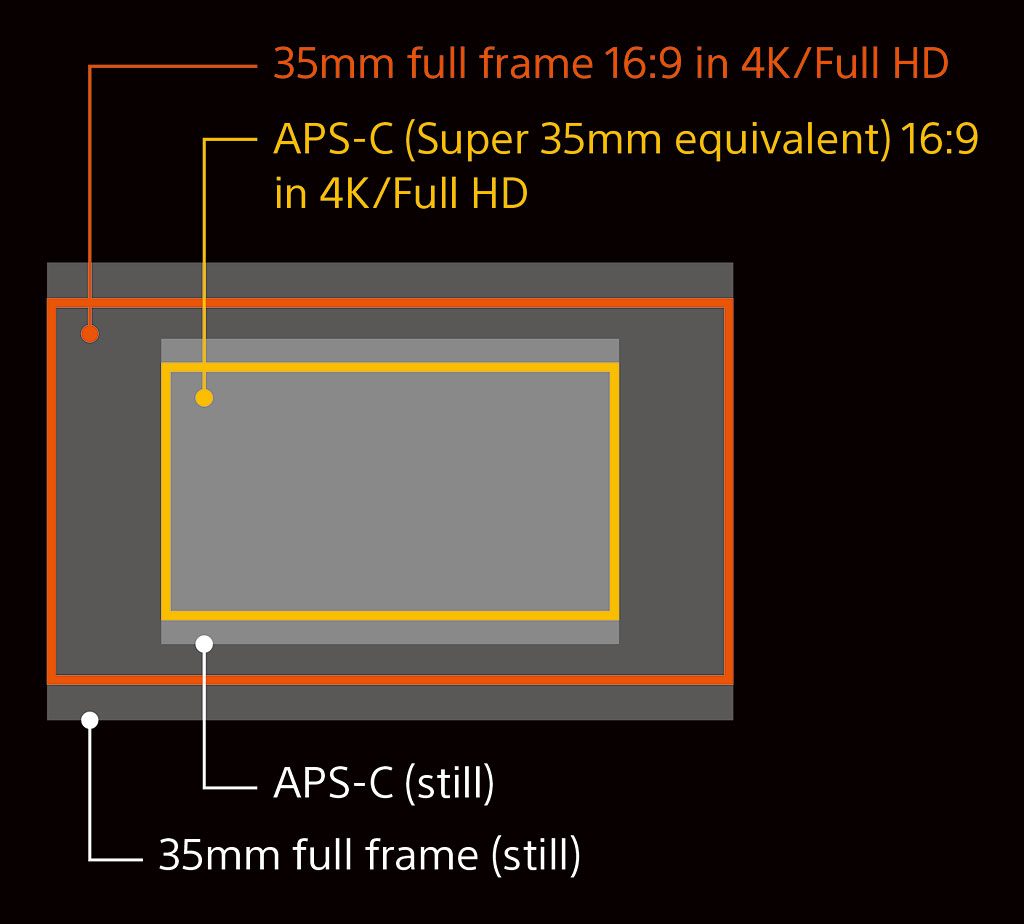
No less important is the fact that the chip can output extremely high-quality, 16:9-aspect, 4K video without line-skipping, pixel binning or downsampling. It’s not quite a native sensor readout, as there’s still an approximate 1.1x focal length crop, but it’s the closest to full-sensor width video we’ve yet seen from a full-frame imager. By contrast, Canon’s EOS-1D C has a 1.3x focal length crop for 4K video, using only an APS-H sized area of the sensor.

The Sony A7S can’t record 4K video directly, but can output an uncompressed 4:2:2 4K video feed via HDMI. You can use the same approach for Full HD video, or alternatively, opt for a choice of XAVC S or AVCHD codecs. Vanilla MP4 is also possible at 1,440 x 1,080 or below.
The A7S’ near-full width 4K mode means you maintain most of the wide-angle capability of your lenses, have more of the shallower depth of field of full-frame area, and still avoid the sort of artifacts caused by the line-skipping approach used in almost all other DSLRs.
It’s also important to note that the Sony A7S can’t record 4K video directly to the internal memory card, but rather passes a clean, uncompressed (8-bit, 4:2:2) 4K 30p/24p stream over its HDMI connection, where it can be recorded on an external device. The reason for this is that the processing required to encode and record the 4K signal internally would have generated far too much heat within the camera body.
 Learn how professional photographer Scott Robert Lim got this shot with his Sony a7S
How Scott got the shot.
Expand your browser window to see this image full-screen
Wedding photographer and Sony Artisan Scott Robert Lim created this captivating image by posing his subject inside a tunnel near the Sky Temple in Beijing, China.
By using available light, shallow depth of field, careful composition and posing, and his rapport with the subject, he was able to craft an intimate portrait with a sense of place in the midst of a crowded tourist destination.
Read what he had to say about creating this photo, and why “Posing is a process”.
The Sony a7S and Zeiss® Sonnar T* FE 55mm f/1.8 ZA lens really shine here. The exceptional dynamic range and low image noise of the Sony a7s preserved detail from the darkest shadows to the brightest highlights, and produced beautiful gradations in between, while the lens delivered great detail wide open, and gorgeous, creamy bokeh.
This content was made possible by support from Sony’s Artisans of Imagery program.
Scroll Scroll
The A7S can record full HD video internally, though, and even offers a choice of AVC codecs. Beyond the standard AVCHD format, the Sony A7S also supports the XAVC S codec, previously found only in Sony’s high-end Handycam professional camcorders. The XAVC S codec was designed to be able to accommodate 4K video, but in the case of the A7S provides high-bitrate full HD, at 50 Megabits/second.
At Full HD resolution (1,920 x 1,080), the Sony A7S can record at frame rates of 60p, 60i, 30p, and 24p directly to the card. The camera can also record in APS-C mode — what Sony calls “Super 35mm-equivalent” — if desired, and in that crop mode can support a high 120 frames per second rate while shooting at 720p (1,280 x 720 pixel) resolution, creating a 5x slow-motion effect.
The Sony A7S also supports what’s known as S-Log2 gamma, a tone curve borrowed from Sony’s pro video recorder line that greatly expands the practical dynamic range of its videos. This special gamma function applies a strong logarithmic tone curve to the sensor’s output, rolling off the highlight end of the curve to preserve highlight detail. Viewed without a corresponding tonal expansion, the resulting video will look very flat, but the dynamic range is expanded over linear encoding by 1,300%, providing enormous dynamic range that can be exploited in post-production.
Other pro-level video functions include the ability to save “picture profiles”, that include settings like gamma, black level and color adjustments. These settings can be shared across multiple A7S bodies, to ensure consistency in multi-camera shoots. The Sony A7S also provides time-code (free-run and rec-run), the ability to synchronize with external devices, marker and zebra displays on both the LCD screen and viewfinder, and can record dual XAVC S as well as MP4 simultaneously (MP4 at 1,280 x 720/30p).
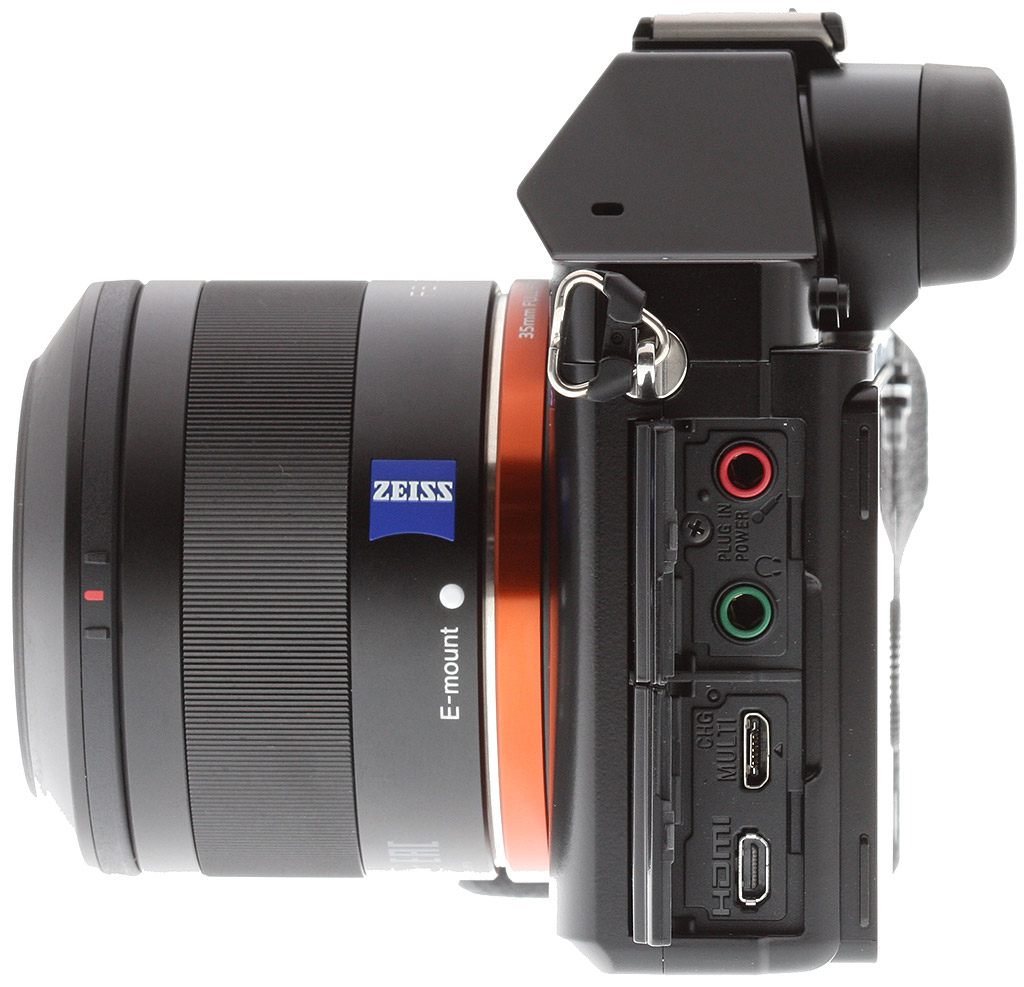
As with other cameras in Sony’s line, the A7S has what the company terms the Multi-Interface Shoe, a proprietary hot-shoe that can provide XLR audio input via the XLR-K1M adapter kit. As part of the A7S announcement, Sony also said that it was developing another mic adapter kit “allowing use of professional microphone systems”, but gave no further details. (Perhaps a system that would provide 48-volt phantom power over the XLR connection? We don’t think the current K1M adapter provides that.)
Like the A7R, the Sony A7S lacks on-chip phase-detection autofocus elemen`ts, so it uses the same “Fast Intelligent AF” as the A7R, a system based solely on contrast detection. Sony promises better autofocus performance on the A7S, though, thanks to the larger pixels on its new sensor. In fact, for low-light autofocus it’s one of the best on the market, able to focus right down to light levels of -4EV, with an f/2.0 lens. (This is one of the lowest-light AF capability we’ve ever heard of, by a full EV step.)
| Differences between the Sony A7S, A7R and A7 | |||
| Camera | Sony A7R | Sony A7S | Sony A7 |
| Body-only List Price | US$2,300 | US$2,500 | US$1,700 |
| Available in Kit with Lens | No | No | Yes |
| Body Materials | Magnesium alloy | Magnesium alloy | Magnesium alloy and polycarbonate |
| Sensor Size | 35.9 x 24.0mm | 35.8 x 23.9mm | 35.8 x 23.9mm |
| Sensor Resolution (Total) | 36.8 mpix | 12.4 mpix | 24.7 mpix |
| Sensor Resolution (Effective) | 36.4 mpix | 12.2 mpix | 24.3 mpix |
| Maximum Image Size | 7,360 x 4,912 pixels | 4,240 x 2,832 pixels | 6,000 x 4,000 pixels |
| Standard ISO sensitivity (Still) | 100 – 25,600 | 100 – 102,400 | 100 – 25,600 |
| Expanded ISO sensitivity (Still) | 50 – 25,600 | 50 – 409,600 | 50 – 25,600 |
| Standard ISO sensitivity (Video) | 200 – 25,600 | 200 – 102,400 | 200 – 25,600 |
| Expanded ISO sensitivity (Video) | N/A | 200 – 409,600 | N/A |
| Electronic First Curtain Shutter | No | Yes, optional | Yes, optional |
| On-chip Phase Detect Pixels? | No | No | Yes |
| Continuous Shooting Rate (with continuous autofocus) |
1.5 fps max. | 2.5 fps max. | 2.5 fps max. |
| Speed Priority Continuous Shooting Rate | 4.0 fps max. (No Continuous AF) |
5.0 fps max. (No continuous AF) |
5.0 fps max. (Continuous AF supported) |
| Autofocus Type | Contrast Detection 25-points |
Contrast Detection 25-points |
Fast Hybrid AF 117-point (phase detect) 25-point (contrast detect) |
| Predictive Autofocus Tracking | No | No | Yes |
| Flash Sync Speed | 1/160 second | 1/250 second | 1/250 second |
| Maximum resolution for HDMI live view | 1,920 x 1,080 pixels | 3,840 x 2,160 pixels | 1,920 x 1,080 pixels |
| Video codecs | AVCHD / MP4 | XAVC S / AVCHD / MP4 | AVCHD / MP4 |
| Maximum clip length | 29 min. (AVCHD); 20 min. / 2GB (MP4) | 29 min. (XAVC S); 29 min. (AVCHD); 20 min. / 2GB (MP4) | 29 min. (AVCHD); 20 min. / 2GB (MP4) |
| 120fps at 720p? | No | Yes | No |
| S-Log 2 gamma option | No | Yes | No |
| Picture profile function | No | Yes | No |
| Time code | No | Yes | No |
| Maximum Magnification (Playback) | 23.0x | 13.3x | 18.8x |
| Battery life (Still) | 340 shots (LCD) 270 shots (EVF) |
380 shots (LCD) 320 shots (EVF) |
340 shots (LCD) 270 shots (EVF) |
| Battery life (Video, clips with power-cycling and zoom) | 60 min. (LCD); 65 min. (EVF) | 60 min. (LCD); 55 min. (EVF) | 65 min. (LCD); 60 min. (EVF) |
| Battery life (Video without power-cycling or zoom) | 90 min. (EVF / LCD) | 90 min. (EVF / LCD) | 100 min. (EVF / LCD) |
| Weight (Body Only) | 14.4 ounces (407g) | 15.7 ounces (446g) | 14.7 ounces (416g) |
| Weight (with battery and Memory Stick PRO Duo flash card) |
16.4 ounces (465g) | 17.2 ounces (489g) | 16.7 ounces (474g) |
In continuous shooting mode, the Sony A7S offers the same performance as the A7 before it: 5 frames per second in speed priority mode, which locks focus from the first shot in the series, or 2.5 fps with autofocus adjustment between frames.
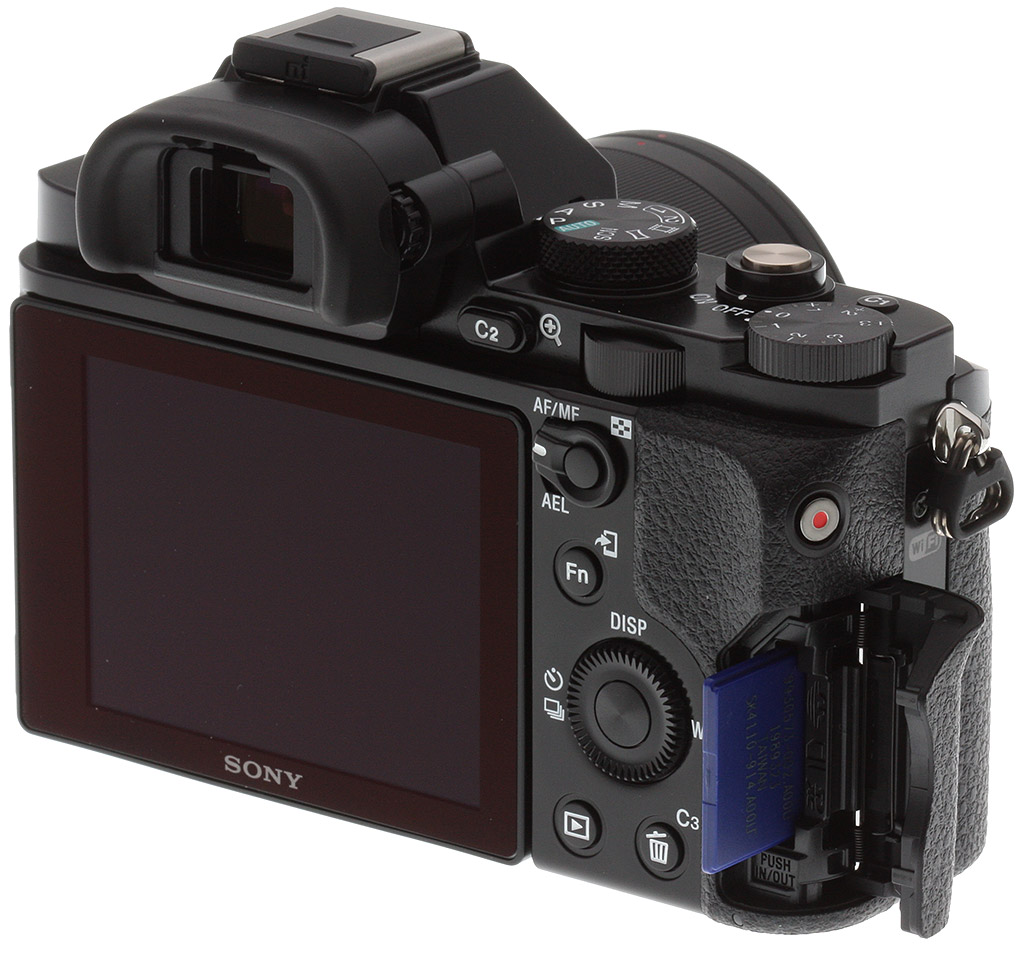
CIPA-standard battery life for still shooting is rated at 380 shots per charge when using the rear-panel LCD, or 320 shots with the electronic viewfinder.
From all the above, it’s clear that Sony had video recording — and particularly 4K video recording — firmly in mind when it developed the A7S. It’d be a mistake, though, to focus solely on that and assume that it’s not a camera meant for still photographers as well.
The sensor’s big pixels and special dynamic-range management capabilities mean it should provide unprecedented low-light capability for still shooters, too, and have very well-controlled noise levels when using high ISOs to freeze action under more moderate lighting as well.
Sony started shipping the A7S in the US market from July 2014. And good news: Body-only list pricing is set at an impressively aggressive US$2,500!
Place your order with a trusted Imaging Resource affiliate now:

The Sony A7S is clearly aimed at videographers — but it offers a whole lot that should prove very exciting to stills photographers, too!
Sony A7 Field Tests
In the Box
The Sony A7S is sold body-only and the retail box contains the following items:
- Sony A7S body
- NP-FW50 Lithium-Ion Rechargeable Battery (1020mAh)
- AC-UB10 AC Adapter
- Shoulder Strap
- Body Cap
- Hot Shoe Cover
- Eyepiece Cup
- Micro USB Cable
- PlayMemories Home App
- Image Data Converter Version 4 Software
- Limited 1-year Warranty
Recommended Accessories
- Large capacity SDHC/SDXC memory card. 16GB Class 10 should be a minimum (SDXC memory card required for XAVC S video format.)
- Sony FE-mount lens: FE 24-70mm f/4 Zeiss or FE 35mm f/2.8 Zeiss
- Extra NP-FW50 Lithium-Ion Rechargeable Battery (1020mAh) (~US$50)
- Sony Vertical Battery Grip for Alpha a7/a7R/a7S Digital Camera (~US$298)
- Sony HVL-F20M External Flash (~US$148)
- External Shotgun Microphone
- External 4K Recorder necessary for 4K video capture
- Small/Medium Carrying Bag