
Fujifilm GFX 50S Review

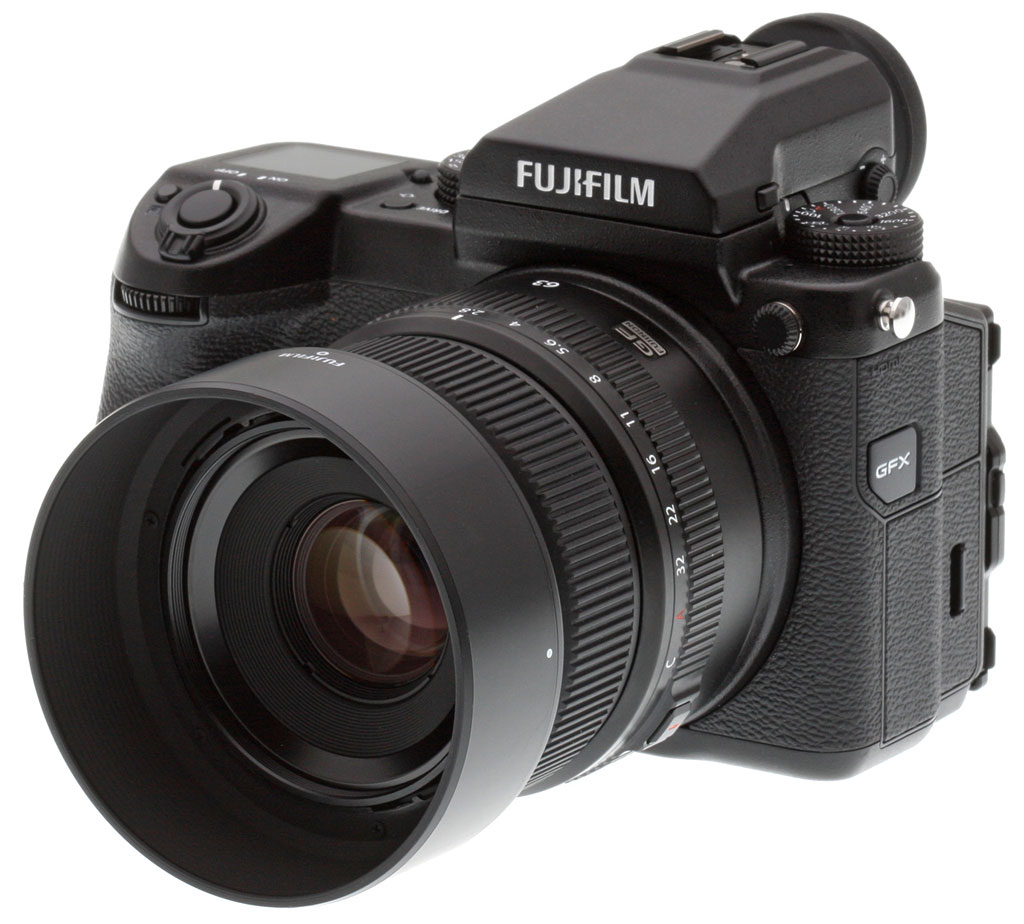
Fuji GFX 50S Review
Fujifilm stole the show back at Photokina 2016 with the surprise development announcement of its GFX 50S, a super-high-res medium-format camera in a mirrorless form factor. Now that we’ve had the chance to put it through its paces both in the lab and out in the field, we’re proud to present our Fuji GFX 50S review for your reading pleasure!
The Fuji GFX system itself is brand new, and it’s clear that Fujifilm’s designers had several key goals for its creation: Keeping size and weight to an absolute minimum, while not compromising on handling or image quality.
At launch, the GFX system was comprised of the GFX 50S camera body itself and three GF lens models. Since then, Fujifilm has announced two additional GF lenses and plans for a sixth to launch by the end of 2017. There are also several GFX accessories including a portrait / battery grip, tilting viewfinder adapter, and adapters allowing use of various medium and large-format lens models from the days of film photography.
 |
The GFX 50S pairs a mirrorless design and high-res 51.4-megapixel sensor
The key to the GFX 50S’ compact form factor is its mirrorless design. Instead of providing a DSLR-style thru-the-lens optical viewfinder, the GFX 50S opts instead for a high-res electronic finder. That decision allowed Fujifilm to do away with the bulky mirror box typical of a medium-format DSLR like Ricoh’s competing Pentax 645Z.
And the advantage of paring down that mirror box is clear: Despite using the exact same sensor size as its Ricoh rival, Fujifilm’s camera is about 5% less wide, 20% less tall and and a whopping 26% less deep, with dimensions of 5.8 x 3.7 x 3.6 inches. Loaded and ready to go, the GFX 50S’ body-only weight is just 29.1 ounces without the electronic viewfinder accessory, or 32.5 ounces with it mounted, again comparing very favorably to the 54.7-ounce weight of Ricoh’s camera. That’s barely more than half the weight of its rival!
 |
And this despite using not just the same sensor size, but also while sporting much the same sensor resolution. Like the Pentax 645Z before it, the GFX 50S offers up around 51.4-megapixel resolution from a 43.8 x 32.9mm, Bayer-filtered CMOS image sensor with approximately 1.7x the light-gathering area of a 35mm full-frame chip.
Although its size and resolution are quite familiar, as is performance which we’ll come to in just a moment, Fujifilm describes the sensor in the GFX 50S as being a “Fujifilm exclusive”, indicating that it’s not the exact same Sony-sourced sensor used in the Pentax 645Z. Of course, that doesn’t necessarily mean that it was an in-house design — it could be a variant of the Sony chip, but with tweaks to the color filter array, microlenses and/or pixel structure to meet Fujifilm’s needs.
 |
We hinted at performance of the GFX 50S in the previous paragraph, and here too Fujifilm’s camera looks to be on level pegging with Ricoh’s now almost three-year old Pentax 645Z design. Like that camera, the GFX 50S will be capable of capturing full-resolution images at up to 3.0 frames per second.
Burst depth is claimed to be on the order of eight uncompressed raw or 13 losslessly-compressed raw frames, with JPEG burst depth essentially limited only by available storage space and power. However, in our lab tests, the GFX captured 40 best quality JPEGs and 21 losslessly-compressed RAW files before slowing. This is significantly better than its closest rival, the Pentax 645Z. The Pentax offers the same burst rate, but could only manage 12 best-quality JPEGs or 10 RAW files before slowing. The GFX’s support of fast UHS-II cards also means buffer clearing is much faster than the 645Z. See our Performance page for details.
Sensitivity is another area in which the GFX 50S looks quite similar to its Ricoh rival at first glance. Both cameras have a base sensitivity of ISO 100 equivalent, with the 50S able to roam as high as ISO 12,800-equivalent by default, and spanning a range from ISO 50 to 102,400-equivalents with its extended sensitivity range enabled. The 645Z doesn’t have an extended range, and instead provides everything from ISO 100 to 204,800-equivalents by default. That gives Fujifilm a slight edge on the lower end of the range, and Ricoh a similar edge at the higher end.
 |
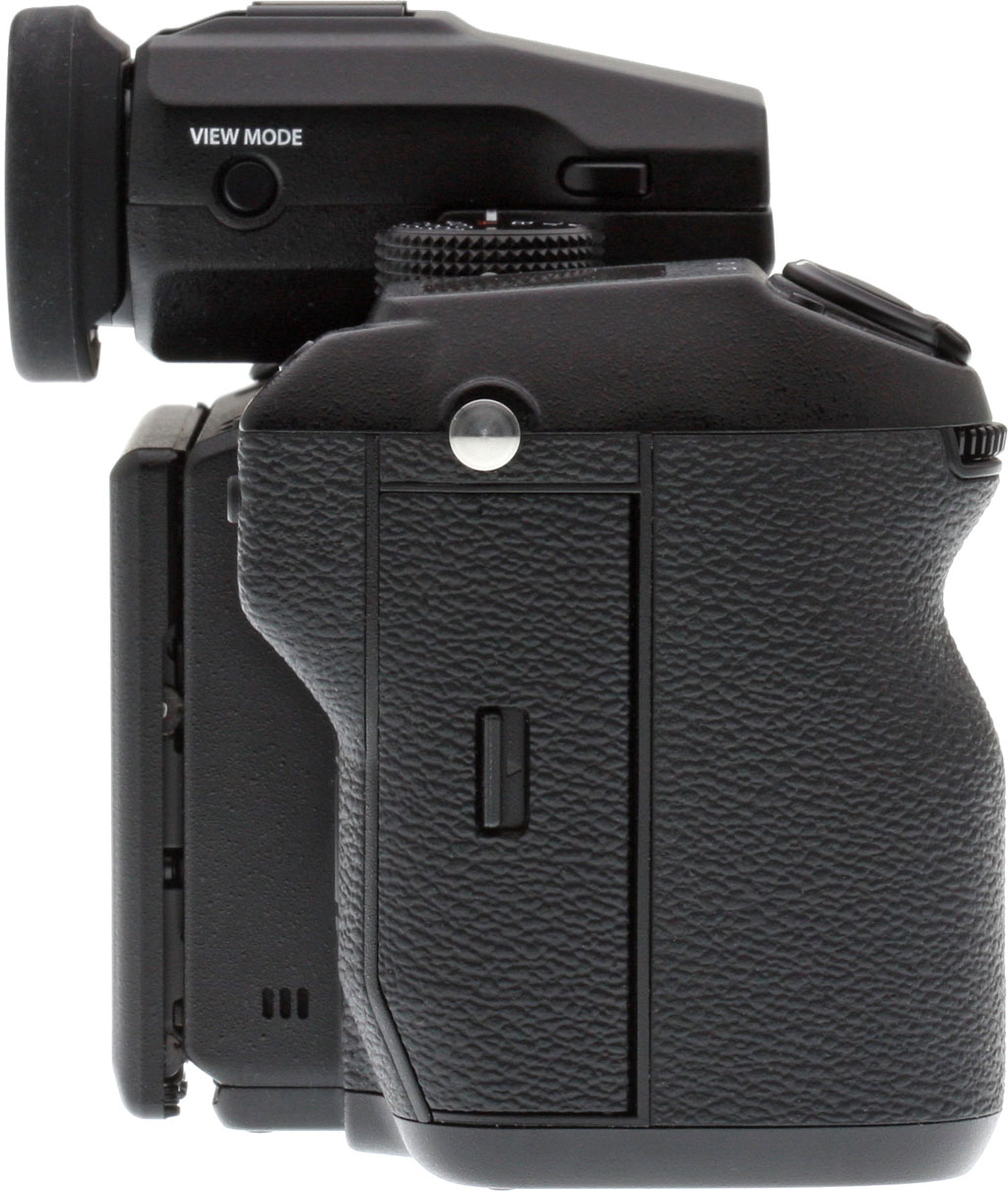
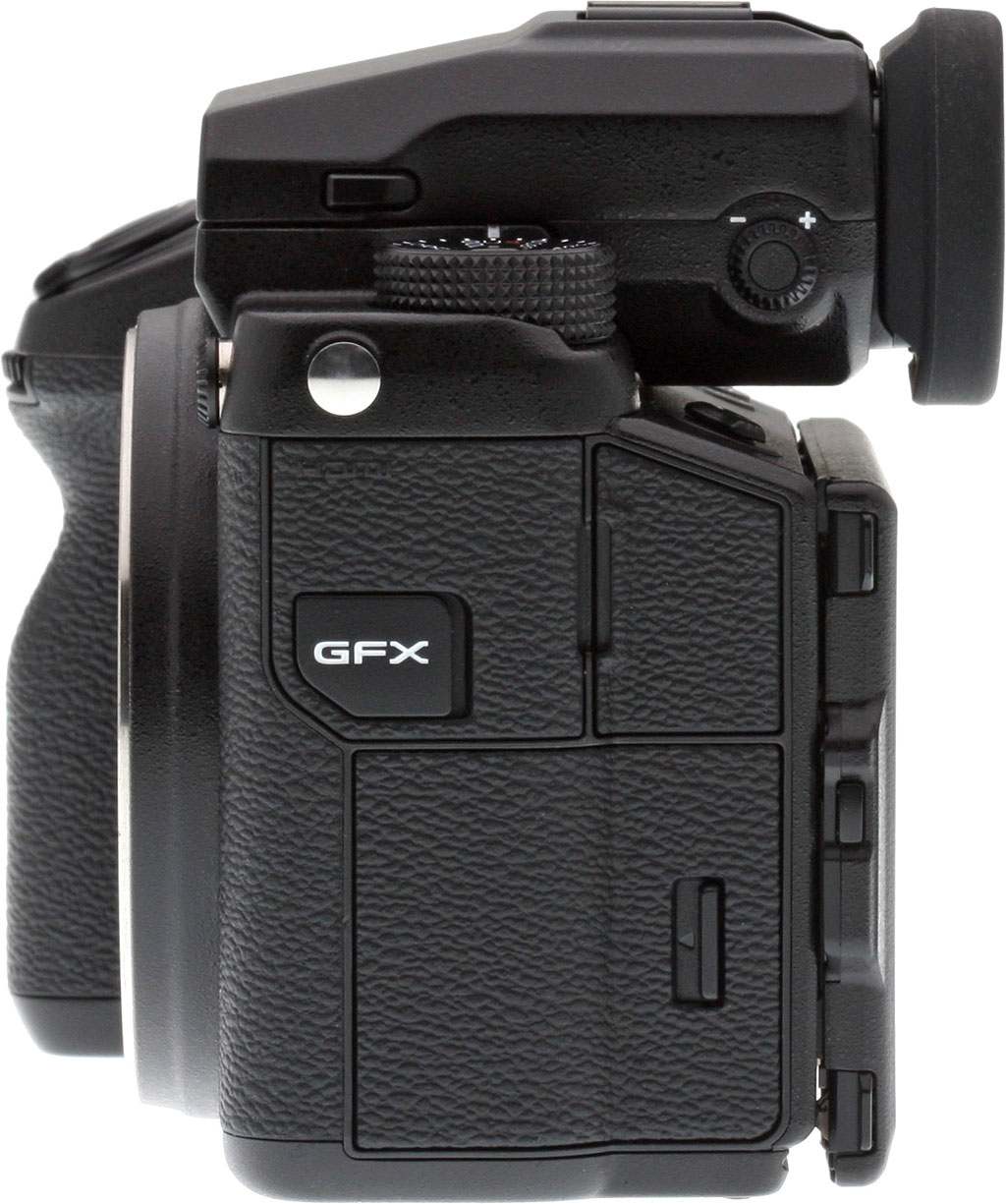
The viewfinder and displays are a couple of areas in which the GFX really distinguishes itself from its Ricoh rival, just as you’d expect of a mirrorless camera. Where the 645Z uses a Keplerian telescopic trapezoid prism finder with 98% coverage, the GFX 50S instead selects a high-res 3.69 million dot organic LED-based finder with 0.85x magnification and a manufacturer-claimed 100% coverage.
 |
And while its rear-panel display has the same 3.2-inch diagonal measurement as in the 645Z, the GFX 50S boasts higher display resolution (2.36 million dots, vs. 1.04 million for the 645Z), a more versatile articulation mechanism (tilting in three directions, vs. two directions for the 645Z) and includes touch-control capability, a feature its Ricoh rival lacks altogether.
There’s also a small monochrome LCD on the top deck of the GFX 50S. It’s rather smaller than the top-deck info display of Ricoh’s camera, but still manages to fit in all of the main exposure variables for at-a-glance confirmation of setup. Interestingly, it has a dark background with lighter text rather than the more typical dark text, light background design used in the 645Z. It also remains active even when the camera is powered off.
Of course, as a camera aimed at pros your purchase doesn’t end at the sales counter. Fujifilm knows that professionals need a high level of service, and the company has stepped up to the plate with its Fujifilm Professional Services program, priced at US$500 per year or thereabouts. You’ll need to register your GFX within 30 days of purchase for eligibility, but once you’ve done so you’ll receive a array of goodies and services.
Member benefits include a welcome kit and swag bag, a personalized Fujifilm Professional Services card with dedicated hotline access, four Check & Clean Program Service vouchers, a 50 percent discount on additional Check & Clean Program Services, two business day turnaround for Check & Clean services, 30 percent discount on non-warranty repairs, two business day turnaround for non-warranty repairs and GFX system loaners for covered equipment while it is being repaired if the repair is expected to exceed two business days.
Read more on the new program here!
 |
Available in the North American market since late February 2017, the Fuji GFX 50S is priced at around US$6,500 body-only, making it just slightly more affordable than the Pentax 645Z, which as of press time now lists for around US$7,000 body-only.
Pricing for the first three Fujinon GF lenses is set at around US$1,500 for the GF 63mm F2.8 R WR, US$2,300 for the GF 32-64mm F4 R LM WR and US$2,700 for the GF 120mm F4 R LM OIS WR Macro.
In the Box
The GFX 50S body-only retail kit (as reviewed) contains the following items:
- Fujifilm GFX 50S (Body Only)
- EVF-GFX1 Interchangeable EVF
- NP-T125 Rechargeable Lithium-ion Battery Pack
- BC-T125 Battery Charger
- Plug Adapter
- Body Cap
- Shoulder Strap
- 2 Strap Clips
- 2 Strap Clip Locks
- Cable Protector
- Hot Shoe Cover (Body/EVF)
- Connector Cover for EVF
- Vertical Battery Grip Connector Cover
- Sync Terminal Cover
- User Manual
- Limited 1-Year Warranty
Recommended Accessories
- Fujinon GF Lenses
- Large capacity SDHC/SDXC memory cards. 32GB should be a minimum, and we highly recommend fast UHS-II cards.
- At least one spare NP-T125 Battery Pack
- VG-GFX1 Vertical Battery Grip
- EVF-TL1 EVF Tilt Adapter
- RR-90 Remote Release
- Camera Bag